Dark Stories True Crime Blog - Page 4

Queensland’s Sliding Doors Moment: Wiretap City

In the 1970s, a gripping arm wrestle was unfolding behind closed doors. Would corruption prevail, or could the anti-corruption forces reclaim the heart and soul of Queensland policing?

The fightback took shape in the early 1970s with the formation of the Whitrod-led CIU (Criminal Intelligence Unit). Their weapon of choice: the wiretap.

The years that followed would prove to be an incredible lost opportunity—what we might now call a sliding doors era. For a time, the anti-corruption forces had successfully neutralised key members of the infamous Rat Pack who were running the Vice Squad’s corruption rackets—either forcing them into retirement or banishing them to remote Queensland country outposts where they could do no harm.

Wiretapping had proven to be a valuable weapon. But despite having what seemed like unlosable, ironclad, open-and-shut cases—backed by wiretap evidence—several high-profile prosecutions were lost.

Wiretapping in Vice City Fortitude Valley

By 1976, the relationship between Commissioner Whitrod and Premier Sir Joh Bjelke-Petersen had completely broken down. The Premier was increasingly interfering in police affairs, demanding the use of the police force as a bulwark against critics and political opponents. Then came the tipping point: Joh recalled one of the rats from the wilderness of country QLD and appointed him Assistant Police Commissioner—directly under Whitrod.

It was intolerable. Whitrod resigned in protest. The end result? The Premier promoted head rat Terry Lewis one more rung to take on the newly vacated top policing job in the state—appointing Terry Lewis as the new Police Commissioner. Like a pied piper, Lewis played his tune—and the rats returned en masse.

The sliding doors moment wasn’t just missed; it was slammed shut. Political corruption was now entrenched at every level, fusing police, underworld, and cabinet interests to a scale never before achieved. Fortitude Valley became further entrenched as the vice capital of Queensland.

But as history would record, the corruption of this era would eventually come crashing down—almost by accident—a decade later. It wouldn’t fall in a single blow—but once the first domino tipped, the downfall of Vice City was unstoppable.

Discuss On Substack

To uncover more Brisbane Crime History, please consider booking tickets to Vice City Fortitude Valley’s True Crime Tour here @ https://darkstories.com.au/vice-city-fortitude-valley-true-crime-tour/.

Spread the word on your favourite platform!

Whispers from Gun Alley: False Prophecy

Madame Ghurka was a prominent and mysterious figure in early to mid-20th-century Melbourne. A medium by trade, she gained notoriety not only for her fortune-telling and palm reading but also for her controversial involvement in one of Melbourne’s most infamous miscarriages of justice—the wrongful conviction of Colin Ross.

Aside from the police, Madame Ghurka was arguably the most influential figure in bringing about Ross’s conviction for the 1921 murder of 12-year-old Alma Tirtschke in what became known as the Gun Alley Tragedy.

Possibly driven by a personal feud with Ross, Madame Ghurka was the first to name him as a suspect in the murder. She later went further, reportedly orchestrating the coming forward of key witnesses whose testimonies proved critical in securing his conviction.

Among them was a former employee of Ross – recently dismissed – who claimed Ross had privately confessed the murder to her. Several other witnesses of dubious character also took the stand to deliver testimony that sealed Ross’s fate and secured their share of reward money for a successful conviction.

Madame Ghurka - Criminologist

Desperate to save him, Ross’s family managed to track down the key witness the day before his execution. She reportedly agreed to recant her story and admit the confession was fabricated—but she never appeared the next morning.

The family’s last minute appeals to the Attorney-General fell on deaf ears with one high ranking official later stating, “Your son had to die Mrs Ross. Had he lived the prestige of the police force would have been shattered”.

It would only be a short while after Colin Ross’s execution that doubt began to grow about the legitimacy of the case. Nearly a century later, in 2008, he was posthumously pardoned—which falls short of an exoneration, and leaves the guilty verdict intact.

As for Madame Ghurka, she briefly continued to dabble in criminal investigations, inserting her “psychic” talents into murder cases that drew public attention, with her notoriety destined to linger to her last days.

Discuss On Substack

To uncover more Melbourne Crime History, please consider booking tickets to Melbourne’s True Crime Tour here @ https://darkstories.com.au/melbournes-true-crime-tour/.

Spread the word on your favourite platform!

On This Day in True Crime History – 15th February

On this day in True Crime History, we revisit the 15th February.

1564: 🌌 Birth of the Heretic Galileo, aka the Father of Science

On this day in 1564, Italian scientist and astronomer Galileo Galilei was born.

Galileo Galilei would be found guilty of heresy by the Roman Catholic Inquisition in 1633. His support for the heliocentric theory, which posited that the Earth and other planets orbit the Sun, directly contradicted the Church’s geocentric view that placed the Earth at the centre of the universe.

Despite Galileo’s efforts to argue that his findings did not conflict with Scripture, the Inquisition ruled that he had violated a 1616 edict that forbade holding, teaching, or defending the heliocentric theory.

As a result, Galileo was forced to recant his views and spent the remaining years of his life under house arrest.

In the 18th century Galileo’s middle finger was removed from his corpse and is now currently on display in the Museo Galileo in Florence, Italy. 🌠🔭📚

This Day in True Crime History

1796: 🌳 The Death of John Black Caesar Australia’s First Bushranger

On this day in 1796, John Black Caesar, also known as Australia’s first bushranger and a figure from Australia’s early convict history, met his end.

Born around 1763, possibly in Madagascar, Caesar’s journey took him from servant in England, to being transported to Botany Bay for theft to notorious bushranger in the colony of New South Wales.

Despite being recognized for his diligence, Caesar’s insatiable appetite led him down a path of repeated theft, resulting in additional sentences and escapes into the bush, where he attempted to live off the land. His repeated efforts to sustain himself outside the confines of the penal colony saw him clashing with local Aboriginal groups and the colonial authorities.

His final escape in December 17-95, leading a gang of absconders, solidified his reputation as Australia’s first bushranger. The pursuit for his capture ended tragically when he was shot to death, but by this time, his legacy in Australian history had been secured.

This Day in True Crime History

1872: ⚖️Execution of the Outlaws Charcoal and Tommy

On this day in 1872, Charcoal and Tommy, were executed for the murder of Samuel Lazenby during a pearl fishing expedition in Port Walcott, Western Australia.

This excursion took a strange turn when Lazenby failed to return from the expedition, with his disappearance cloaked in betrayal and violence. The subsequent investigation resulted in the discovery of Lazenby’s body – partially buried and identifiable by peculiarities in his jaw and the clothing he was last seen wearing.

Captured and subjected to trial, Charcoal and Tommy faced overwhelming evidence against them. Witness testimonies, coupled with the recovery of Lazenby’s belongings and fragments of his boat in their possession, painted a damning picture. Despite their pleas of innocence, the jury delivered a swift and unanimous guilty verdict. 🎣⚖️🕵️‍♂️

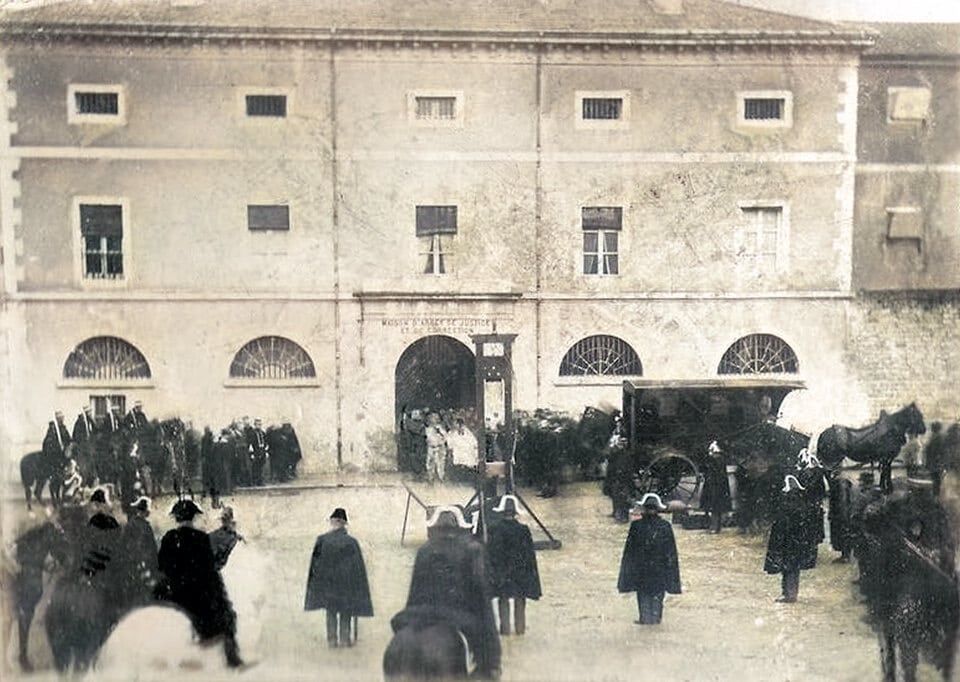
Fremantle Prison Execution
Spread the word on your favourite platform!

On This Day in True Crime History – 8th February

On this day in True Crime History, we revisit the 8th February.

1587: ⚔️ The Execution of Mary, Queen of Scots, for Suspected Conspiracy

On this day in 1587, Mary, Queen of Scots, a figure entwined in political intrigue and dynastic struggles, was executed. Born in 1542, she became queen of Scotland at just six days old after her father’s death.

Her early life was marked by a brief betrothal to the English Prince Edward, a move that sparked conflict due to religious differences. She was instead sent to France, where she married Francis II, becoming queen consort of France at 16. Widowed at 18, she returned to Scotland, a realm divided by religious strife.

Mary’s reign in Scotland was turbulent, characterized by her marriage to her cousin Lord Darnley, whose murder and her subsequent marriage to the prime suspect, the Earl of Bothwell, led to widespread scandal and her forced abdication in favor of her infant son, James VI of Scotland (later James I of England).

Fleeing to England for protection, she became a prisoner of her cousin, Elizabeth I, due to her strong Catholic claim to the English throne. After 19 years of captivity she was caught in conspiracy to murder Queen Elizabeth, leading to her demise, leaving a legacy of martyrdom for her Catholic supporters.

Her execution was infamously botched and took three blows of the axe to complete the job. ⚖️👑📜

This Day in True Crime History

1792: 🍞 James Collington’s Execution for Bakery Burglary

On this day in 1792, James Collington met a grim end, hanged for the theft of bread and flour from the hut of John Campbell, a laborer who provided baking services to the public, as well as a check apron belonging to Susanah Bray, who resided in the same dwelling.

At the hanging tree he addressed the convicts, warning them to avoid the path he had pursued; but said, that he was induced by hunger to commit the crime for which he suffered. He appeared desirous of death, declaring that he knew he could not live without stealing.

This severe punishment for seemingly petty theft was considered necessary as a means for keeping law and order intact owing to the near starvation rations that existed in the colony at this time. 🏚️⚖️💔

This Day in True Crime History

1799: 🚨 James Reece’s Desperate Final Act Before Execution

On this day in 1799, James Reece was hanged for a crime involving a sow, which was a capital offence under the severe moral and legal codes of the time.

Reece’s case was particularly notable not only for the nature of the crime but also for his actions on the day of his execution. Having previously been granted a reprieve at the gallows, Reece made a desperate attempt to escape his fate by attempting to cut his own throat on the morning he was to be executed.

The attempt was not fatal and was likely an attempt to buy more time in order to plan an escape attempt rather than a genuine desire for death.

This Day in True Crime History

1879: 🏦 Ned Kelly’s Daring Raid on Jerilderie

On this day in 1879, the notorious Ned Kelly and his gang executed one of their most audacious heists, targeting the small town of Jerilderie.

In a display of cunning and boldness, they captured two police officers, securing them in their own cells, before proceeding to rob the local bank. This event not only showcased the gang’s expert planning and brazenness but also highlighted Kelly’s complex relationship with authority and his sense of social justice.

His declaration, “I am a widow’s son outlawed and my orders must be obeyed,” underscored his defiance and the desperate resolve of a man cornered by circumstances.

The raid culminated in the drafting of The Jerilderie Letter, an outlaw’s manifesto that served as a poignant narrative of Kelly’s grievances against the police and the judicial system, sealing his legacy as one of Australia’s most emblematic and polarizing figures. 📜🔒💰

Ned Kelly

1950: 🕵️‍♂️ The Founding of the Stasi in East Germany

On this day in 1950, East Germany saw the establishment of the Stasi, or “Staatssicherheit,” marking the inception of one of the most repressive and feared secret police agencies in the world.

The Stasi was notorious for its extensive surveillance and espionage activities, both within East Germany and abroad, aimed at suppressing dissent and controlling every aspect of citizens’ lives. Its methods included informants, wiretapping, and extensive personal surveillance, creating an atmosphere of fear and mistrust among the population.

The agency’s vast network and ruthless tactics made it a symbol of the oppressive nature of East German communist rule. The Stasi was dissolved in 1990, following the fall of the Berlin Wall and the subsequent reunification of Germany, but its legacy remains a chilling reminder of the dark side of surveillance and state control. 🔍💔

Stasi
Spread the word on your favourite platform!