1920: The Wagon That Vanished: New York’s Unsolved Wall Street Bombing

At 12:01 pm on September 16, 1920, a horse-drawn wagon parked across from the J.P. Morgan & Co. headquarters at 23 Wall Street exploded, packed with 100 pounds of dynamite and 500 pounds of cast-iron sash weights turned into shrapnel. Thirty people died instantly and eight more later succumbed to their wounds, with 143 seriously injured and hundreds hurt in total. Witnesses saw the driver step down and vanish down a side street moments before the blast; he was never identified.

Within a minute, the New York Stock Exchange president suspended trading to head off panic. A 17-year-old messenger, commandeered a parked car and used it to ferry 30 wounded victims to hospital as police seized nearby vehicles for the same purpose. Crews worked through the night to clear the wreckage so the Exchange could reopen the next morning, but in doing so destroyed evidence that might have identified the bomber.

Investigators from the Bureau of Investigation, forerunner of the FBI, suspected the attack was the work of Galleanist anarchists responsible for a string of bombings the previous year, but no one was ever charged. More than a century on, the Wall Street bombing remains unsolved, its perpetrator and motive still unknown.
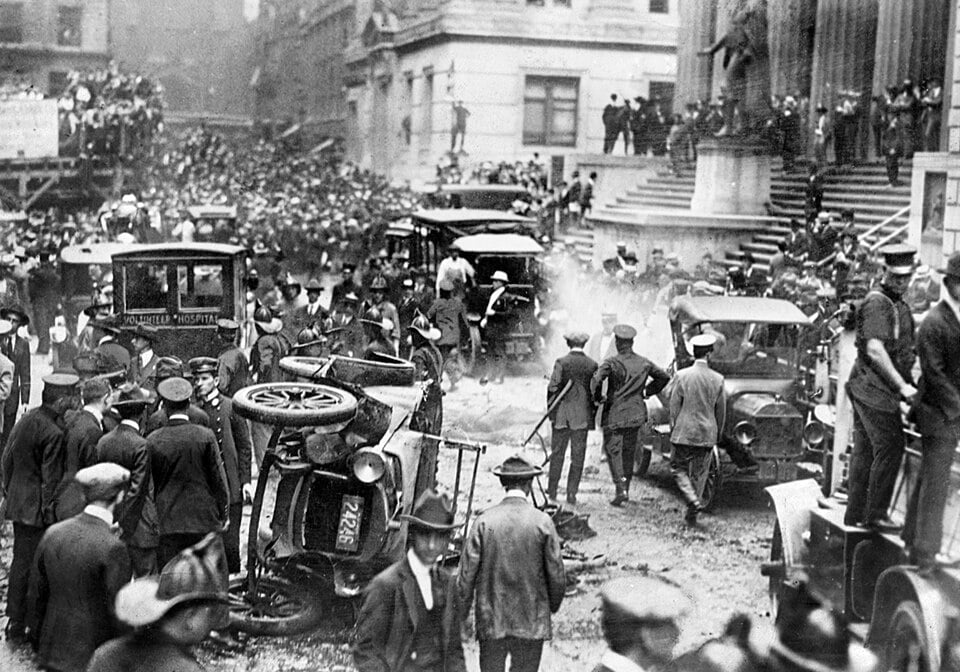

Historic photo of bombing aftermath on Wall Street

⬅ See all events from 16 September

Spread the word on your favourite platform!
True Crime Scene Tape

2002: The Monster Butler Archibald Hall Dies in Prison as the Oldest Whole-Life Inmate in Britain

Archibald Hall began as a teenage thief in Glasgow before reinventing himself behind bars, studying antiques and taking elocution lessons to erase his Scottish accent. He adopted the alias Roy Fontaine, borrowed from actress Joan Fontaine, and used the new identity to work as a butler to British aristocracy.

The disguise concealed a killer. In 1977, Hall shot a gamekeeper during a staged rabbit hunt after the man threatened to expose his criminal past, then buried him beside a stream. Later, while working for a former Labour MP and his wife, Hall and an accomplice suffocated the wife after she caught them plotting to rob the couple. They drugged her husband and drove him to Scotland, where they buried her body before strangling him and beating him with a shovel. The couple’s housekeeper was also murdered during the spree.

Convicted of four murders, Hall was sentenced to life in prison without parole. He died behind bars in Portsmouth, England, with the Monster Butler persona outliving the man who had built it.

The Butler Did Do It

⬅ See all events from 16 September

Spread the word on your favourite platform!
True Crime Scene Tape

1811: A Last-Minute Recantation at the Gallows Delays the Execution of John Dunn at Parramatta

John Dunn, Thomas Welch and Ann Wilson were charged before the Court of Criminal Jurisdiction at Parramatta with the murder of Mary Rowe. After a lengthy hearing, the court convicted Dunn of the murder largely on the evidence of an accomplice, John Welch, a boy of about sixteen.

Dunn was ordered hanged the following Monday, between eight and twelve. But as the execution was about to proceed, the teenage witness suddenly retracted his sworn testimony in front of the assembled spectators, declaring that Dunn was innocent and that he and his father, Thomas Welch, were the true killers. The Acting Provost Marshal, with no precedent to guide him, respited the hanging, which did not take place until the following Wednesday, under far gloomier circumstances than before.

Despite the boy’s dramatic gallows reversal accusing himself and his father of the killing, the original verdict against Dunn stood and his execution went ahead two days later than planned.

Lady Justice Themis statue on gallows with scales and sword

⬅ See all events from 16 September

Spread the word on your favourite platform!
True Crime Scene Tape

1889: He Gave Away His Victim’s Wedding Ring: Hanged at Melbourne Gaol for the Carlton Murder

Annie Thornton, was murdered in her home at Carlton, a suburb of Melbourne, on the night of 10 July 1889. Piercing screams were heard coming from the house that night, but no neighbour intervened and nothing was reported to police until the inquest weeks later.

The man committed for trial, Filipe Castillo, showed almost total indifference to his fate. On the very night of the killing he was seen with another woman and showed her a bloodstained waistcoat, claiming it came from a cut to his arm. He then handed out jewellery stolen from the dead woman to several other women, including the wedding ring he had taken from her finger.

The murdered woman’s husband, Henry Thornton, had been living apart from his wife and was working in Ballarat at the time. On hearing of the killing he walked into the Ballarat watch-house himself, gave a detailed account of his movements and produced letters proving he had not seen his wife since parting from her on good terms months earlier; he was cleared of any involvement.

At the inquest a verdict of wilful murder was returned, and the accused was described as remarkably unconcerned throughout the proceedings. He was tried, convicted and hanged at Melbourne Gaol on 16 September 1889 for one of the most brutal and cold-blooded murders Melbourne had seen.

Bag of jewels spilled open with gems falling out

⬅ See all events from 16 September

Spread the word on your favourite platform!
True Crime Scene Tape
On This Day in True Crime History

Subscribe to Dark Stories

True crime stories, dark history and tour news, straight to your inbox.