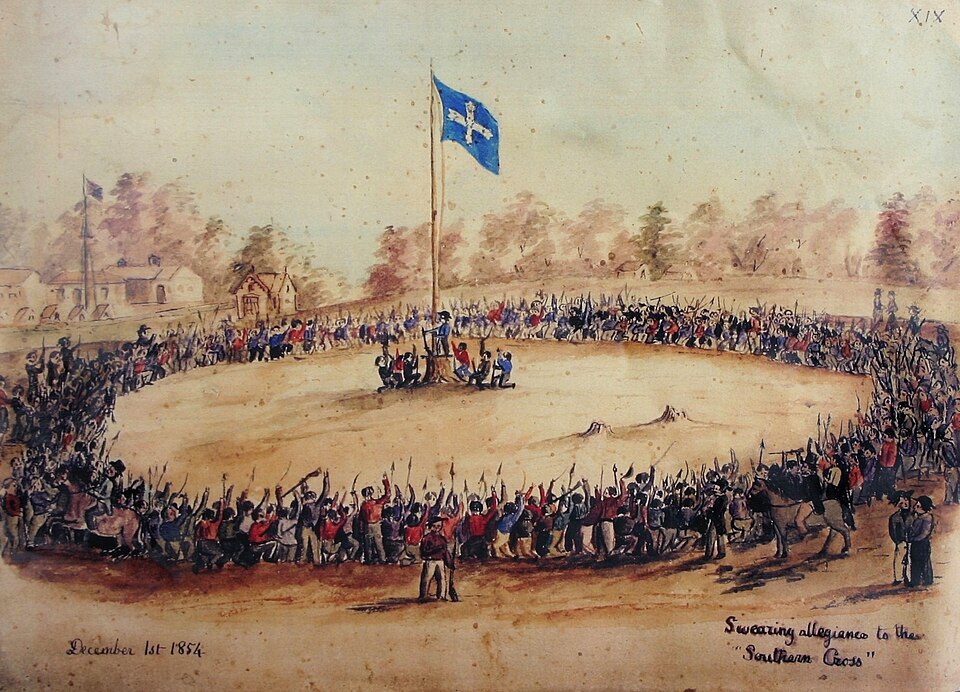
More than 10,000 diggers crowded onto Bakery Hill, directly opposite the government camp in Ballarat, and formally established the Ballarat Reform League under the Chartist John Humffray on this day in 1854. The resolutions they passed were blunt: full democratic representation, the vote for every man, and an end to being governed without a say in it.
They did not stop at petitioning. The League declared that if their demands went unmet, the diggers would secede from the United Kingdom altogether, a threat of open rebellion against the Crown. Weeks later that defiance would end in gunfire at the Eureka Stockade.
At a roadside shanty near Mansfield in Victoria, a servant working for shanty keeper Robert Scott was shaken awake by his master's lodger, David Gedge, who admitted his own earlier shot at the delirious, drink sick Scott had failed to go off. Told it was his turn, the servant balked, unsure if Scott's wife would want her husband dead. Gedge sent him to ask her. She said yes, and handed him a glass of brandy before he carried the loaded gun into the bedroom and shot Scott dead on 11 April 1863.
The three staged it as a suicide, the servant forcing Gedge at gunpoint to swear he would never tell. Within a day Gedge turned informer, naming the servant as the man who fired the shot. Confronted, the accused gave his own account in full: Gedge had melted shot in a frying pan to mould a bullet, and Scott's wife had ordered the killing and poured the brandy that steadied his hand.
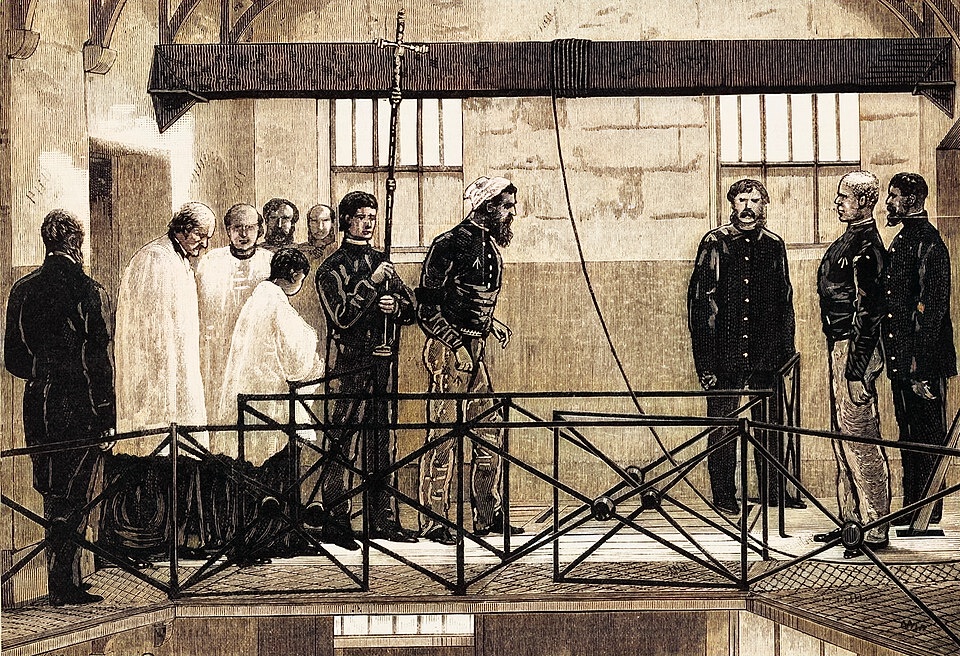
All three were tried together and convicted. On this day in 1863, the servant was hanged in Melbourne alongside Gedge and Scott's wife, who became the first woman executed in Victoria.
He never denied firing the shot, but to the last maintained he had done so only on Scott's wife's order, after she answered yes and gave him the brandy that sent him to the bedroom.
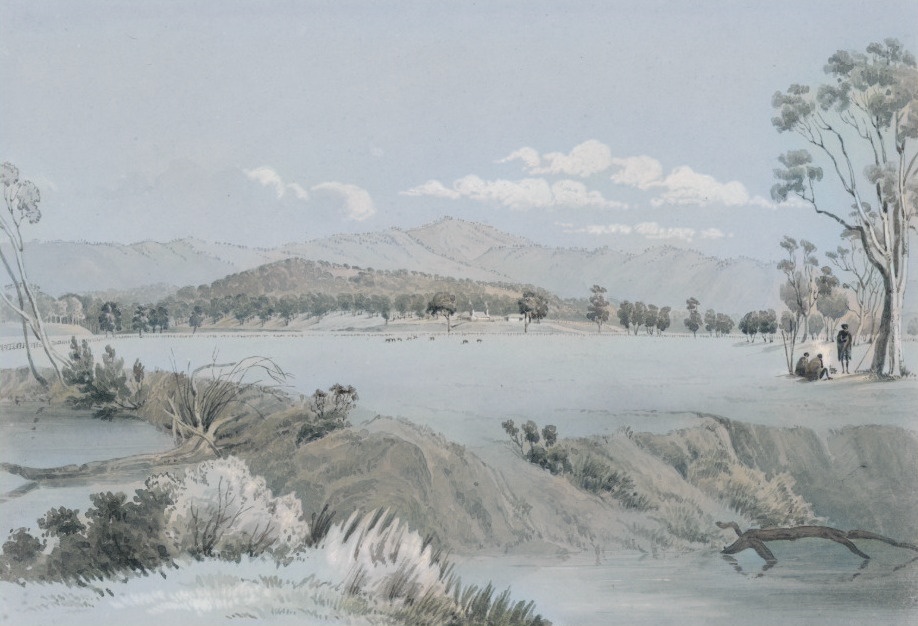
Devil's River district, near Mansfield, where the 1863 murder of Robert Scott took place. Artwork by Edward William Jeffreys, c. 1841–1845. State Library VIC
David Gedge was a 19 year old groom at a bush shanty near Mansfield, and the lover of the wife of its keeper, Robert Scott, who lay dying of delirium tremens in his bed. Gedge tried to shoot him himself, but the pistol would not fire, so he turned to Julian Cross, a servant on the property, melted down a charge of shot into a crude bullet, and ordered him to finish the job. After the single shot rang out, Gedge forced Cross to his knees and swore him to secrecy, then told the search party that Scott had killed himself.
The story collapsed within a day, and Gedge was the first to turn on his accomplice, naming Cross as the shooter. He, the victim's wife and Cross were all convicted of murder and hanged together in Melbourne on this day in 1863.
On the scaffold, the victim's wife turned to Gedge and asked him to clear her. He said nothing, and the trapdoor fell a moment later.
Devil's River district, near Mansfield, where the 1863 murder of Robert Scott took place. Artwork by Edward William Jeffreys, c. 1841–1845. State Library VIC
Elizabeth Scott ran a bush shanty with her husband Robert Scott on the road between Mansfield and the Devil's River, nursing him through a bad bout of delirium tremens while carrying on with her young groom, David Gedge. One night that April she sent a household servant into the sickroom with a loaded pistol; he shot Robert Scott where he lay, and the household then tried to pass the death off as a man taking his own life with a pistol left carelessly on the bed.
The story unravelled fast. The servant and Gedge each turned on the other, and both swore Elizabeth Scott had ordered the killing and handed over the gun herself. Tried and convicted alongside the two men, she was hanged in Melbourne on 11 November 1863, the first woman executed in the colony of Victoria.
On the drop she turned to Gedge and asked if he would not then "clear her". He said nothing, and the bolt was drawn.
Devil's River district, near Mansfield, where the 1863 murder of Robert Scott took place. Artwork by Edward William Jeffreys, c. 1841–1845. State Library VIC