1911: Hammer in Hand: 223 Arrested After a Night of Smashed Windows in a London Suffragette Protest

When police blocked their march on the House of Commons on this day in 1911, the suffragettes did not retreat, they regrouped. Small bands broke off down Whitehall, the Strand and Fleet Street, smashing shop and office windows with hammers and stones. One woman peeled off at Horse Guards Parade alone and broke fifteen windows at the Board of Trade before she was finally arrested. By the end of the night 223 people, nearly all of them women, had been taken into custody, and every one of them chose a prison term over paying a fine.

The campaign worked precisely because the police could not fight back as they would against men. Newspapers described one elderly woman in a lace shawl who hurled herself again and again at a police line, seeming to the watching crowd to renew her youth with every charge, before she too was dragged off. It was, as suffragette leader Emmeline Pethick Lawrence had promised beforehand, a deliberate push to the floor of Parliament that was bound to fail and was always meant to end in arrest.

Full suffrage was still decades away that night, but the tactic of forcing mass arrests through property damage became the blueprint for the militant campaign that followed.
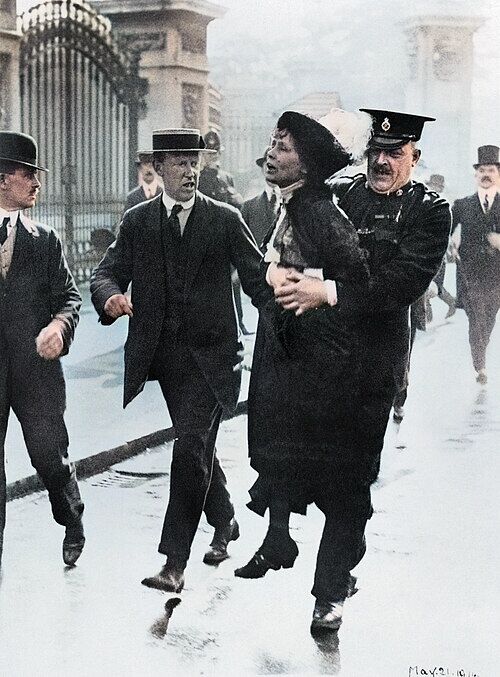
Mrs Emmeline Pankhurst arrested outside Buckingham Palace

⬅ See all events from 21 November

Spread the word on your favourite platform!

1953: The Missing Link That Never Was: How Piltdown Man Fooled the World for 41 Years

For decades Piltdown Man stood as scientific proof that humanity began in England: a skull unearthed in a Sussex gravel pit in 1912 by amateur archaeologist Charles Dawson, paired with an ape like jaw and hailed by leading scientists as the long sought missing link between ape and man. Careers and reputations were built analysing the bones, and rival fossils from Africa were dismissed because they did not fit the English find.

On this day in 1953, the British Natural History Museum declared it all a fraud. The jaw belonged to an orangutan, its teeth filed down and stained with chemicals to mimic a fossil hundreds of thousands of years old, while the skull itself was barely a few centuries old. Forty one years of research, and the standing of the men who had championed it, collapsed overnight.

Decades later, DNA analysis traced the forgery back to Dawson himself, a man hungry for professional recognition who had faked archaeological finds for years before Piltdown and planted a second skull afterwards to make the first seem beyond doubt.

Piltdown Man: Reconstruction of Eoanthropus dawsoni: 1913

⬅ See all events from 21 November

Spread the word on your favourite platform!

1971: Caught by His Own Diary: The Teacup Poisoner Graham Young Arrested Again

After having already served eight years in Broadmoor for poisoning his own family as a teenager, Graham Young was arrested for the second time at his aunt and uncle's home in Sheerness, Kent, on this day in 1971, after colleagues at his workplace began falling gravely ill and dying from symptoms doctors could not explain.

A search of his bedsit uncovered a stash of poisons and a diary in which he had meticulously recorded the doses given to each victim, tracking their reactions like a scientist logging an experiment.

He was later convicted of murdering two colleagues and was sentenced to life imprisonment, the diary standing as the clearest evidence against him.

Poison being added to a teacup

⬅ See all events from 20 November

Spread the word on your favourite platform!

1971: The Teacup Poisoner Claims a Second Victim, Undone by His Own Arrogance

Graham Young, later dubbed the Teacup Poisoner, had already served eight years in Broadmoor for poisoning his own family as a teenager when he talked his way into a storeroom job at a Hertfordshire laboratory in 1971. Using the tea trolley to slip thallium and antimony into his colleagues' mugs, he turned the workplace into his private laboratory, watching co-workers sicken with a mystery illness the staff nicknamed the Bovingdon Bug. His first victim there, a storeroom supervisor, had already died that July, his death wrongly put down to a rare nerve disorder.

Fred Biggs, a local councillor working part time at the firm, was next. Young slipped three doses of thallium into his tea and watched him deteriorate through a string of hospital transfers, his central nervous system failing until he could no longer speak. Biggs died on 19 November 1971. By then suspicion was already closing in: Young, unable to resist showing off his knowledge, had argued with the company doctor that the symptoms pointed to heavy metal poisoning, a remark that would prove impossible to take back.

The Teacup Poisoner Strikes Again

⬅ See all events from 19 November

Spread the word on your favourite platform!
On This Day in True Crime History

Subscribe to Dark Stories

True crime stories, dark history and tour news, straight to your inbox.