At 9:30 pm on 5 September 1994, Labor MP John Newman was shot twice and killed instantly in the car park of his Woods Avenue home in Cabramatta, in the western suburbs of Sydney.
His fiancee, Lucy Wang, was present but saw little due to the speed of the attack; she reported a hooded man in an army-style jacket who fired four shots and fled in a waiting car. Newman had represented Cabramatta in the NSW Legislative Assembly since 1986 and had campaigned aggressively against organised crime and drug trafficking in the area. Newman was later given a state funeral. He was 47 years old.
Thomas Woolcock died at 3 am on 4 September 1873 in Moonta, Adelaide having suffered weeks of stomach pains, nausea, and prolonged vomiting. His death was initially attributed to exhaustion, but suspicion quickly fell on his wife Elizabeth Woolcock, a woman whose own life had been marked by hardship, abuse, and desperation.
Elizabeth had endured years of violence at the hands of Woolcock, a heavy-drinking wife-beater who had repeatedly prevented her from leaving. In the weeks before his death, she had made increasingly frantic attempts to obtain morphine and other substances from local chemists, and her behaviour had become talk of the community. Charged with murder by mercury poisoning, Elizabeth was tried, convicted, and hanged at Adelaide Gaol on 30 December 1873. She remains the only woman ever executed in South Australia.
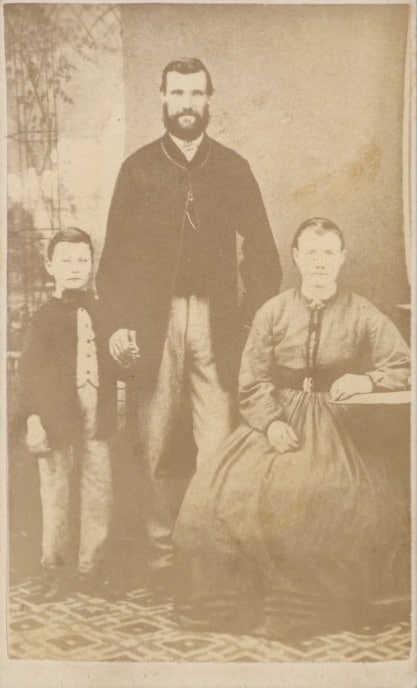
Elizabeth Lillian Woolcock with her husband Thomas and their son Tom, c.1865. State Library of South Australia, B 12311. Public domain.
On a wet, cloudy night in 1857, Chong Sigh and Hing Tzan entered the brothel of Sophia Lewis on Exhibition Street, in Melbourne, intending to rob and murder her.
Chong Sigh cut the sleeping woman’s throat, but the first wound was not fatal. Hing Tzan held her down while a second, deeper cut was made. When Lewis moved again, Hing Tzan returned to her and, according to the men’s later confession, almost severed her head from her body.
The pair then plundered the room and slipped away into the night, narrowly avoiding a constable on his beat before eventually scattering to Geelong and Ballarat.
Both men were arrested, confessed and were convicted of murder. Their statements confirmed that Chong Sigh had conceived the plot, with robbery as the motive, while Hing Tzan carried out the final fatal attack.
At Melbourne Gaol, the two men presented a striking contrast on the scaffold. Chong Sigh was overcome with emotion and cried loudly, while Hing Tzan remained comparatively composed and appeared to chant a prayer. Hing Tzan briefly resisted when the execution cap was placed over his head, apparently fearing that his hair was about to be cut, but quickly became calm. Both men were hanged on 3 September 1857.
Hooded man holding a glowing lantern in a dark forest
In December 1884, plain-clothes Detective Sergeant Hyland was pursuing a suspect wanted as an accomplice in a wool-stealing robbery at Kyneton. Acting on a tip that the man had been seen asking questions near the Gong Gong hotel, Hyland and Senior Constable Hehir hired a cab and tracked him along the road near Brown Hill. When Hyland stepped out and approached, the man drew a revolver and shot him in the shoulder at close range. Hyland rushed him before he could fire again, and a fierce struggle followed, with two more shots discharged into the ground and air before the man was handcuffed and taken into Ballarat. Surgeons at the hospital extracted the bullet from the sergeant’s back.
The man, Charles Bushby, also known as Baker, was convicted of attempted murder at the Ballarat Court and sentenced to death. He was hanged at Ballarat on 3 September 1885.
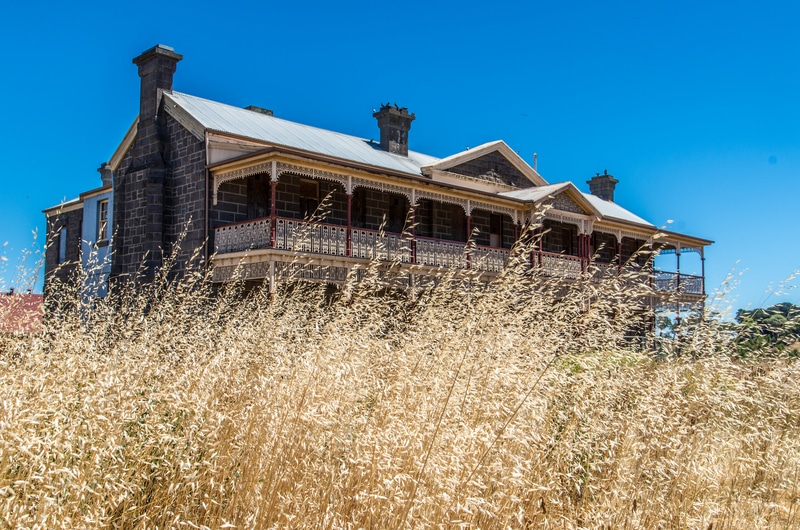
Old abandoned Kyneton Hospital building in Victoria, Australia