1870: Beheaded His Mate, Burned the Hut, But the Skull Survived: Hanged in Melbourne

James Seery shared a goldfields hut with August Tepfar on the Crooked River diggings in Gippsland, and when Tepfar failed to turn up for work one morning, no one suspected murder until Seery's own hut was found ablaze. In the smouldering ruins searchers found a human skull and the charred remains of a dog; nearby, Tepfar's headless body lay buried between two slabs arranged like a makeshift coffin, his severed head carried off to the fire for reasons no one could explain.

Seery made for the old diggings he had once worked, but two days later Mounted Constable Lloyd caught up with him on the track. Seery rushed the trooper with a long handled shovel, snarling "I'll split your skull" before he was wrestled to the ground, blood still staining his shirt. Convicted with no motive for the killing ever established, he was hanged at Melbourne on 14 November 1870.

He went to the gallows without explaining what had driven him to kill his mate; as one report put it, Seery said nothing to throw any light on the mystery.
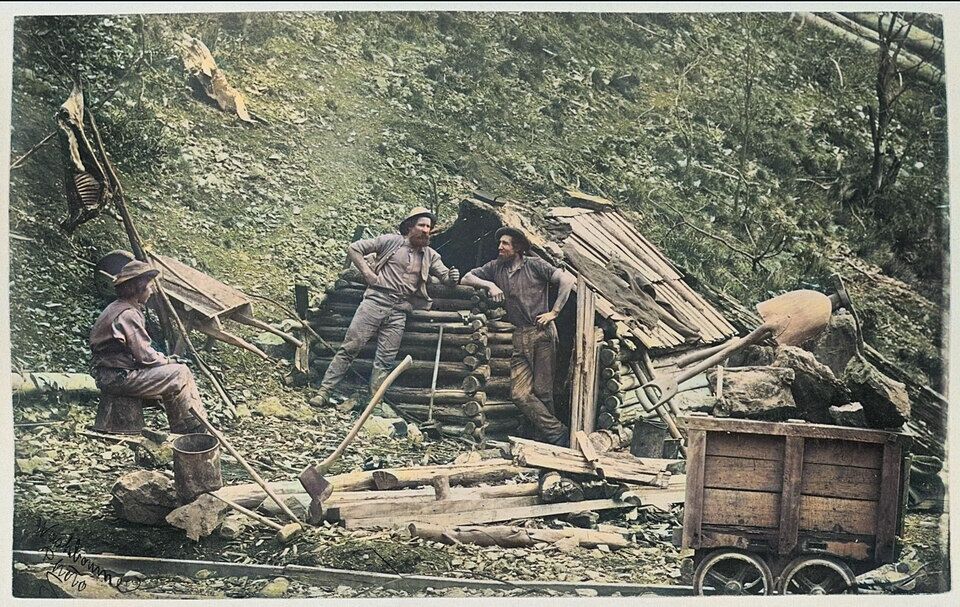
Prospectors hut, Gippsland, Victoria, about 1870

⬅ See all events from 14 November

1990: Shouting "Kill me!": The Deadliest Mass Shooting in New Zealand Ends in a Police Shootout Near Dunedin

In the small coastal settlement of Aramoana, near Dunedin, an argument with a neighbour over a wandering child spiralled into one of the country's worst mass shootings. On the evening of 13 November 1990, David Gray took up a semi-automatic rifle and moved from house to house through the township, killing thirteen people, among them young children, and setting fire to the home of his first victim.

Sergeant Stewart Guthrie, the first armed officer to respond, tracked Gray through the darkness and ordered him to surrender. Gray called out, "Don't shoot!", leading the sergeant to believe he was giving himself up, then opened fire moments later and killed him instantly.

Police sealed off the township and spent the next day searching house by house before cornering Gray in a holiday home. On 14 November 1990, he burst outside firing from the hip, shouting "Kill me!", and was shot down by an elite police squad. He died a short time later in the ambulance taking him to hospital.

Aramoana massacre memorial. Photo: Benchill, Wikimedia Commons, CC BY-SA 3.0 (https://commons.wikimedia.org/wiki/File:Aramoana_massacre_memorial.jpg

⬅ See all events from 14 November

1995: He Phoned a Journalist to Boast of 76 Victims: The Capture of the ABC Serial Killer

Moses Sithole murdered at least 37 women and a toddler across South Africa between July 1994 and late 1995, the killings spread between three towns so that newspapers dubbed him the ABC Killer. Police lost his trail that August after linking him to one victim and uncovering an earlier conviction for an assault on a woman, and the case went cold until Sithole himself broke the silence, phoning a journalist to claim the murders were revenge for his unjust imprisonment and boasting of 76 victims, twice the official count, before giving directions to a body to prove he was telling the truth.

The call let investigators close in, and on 6 November 1995 police cornered Sithole in Johannesburg. He attacked a constable with a hatchet during the confrontation and was shot by officers, bringing the manhunt to an end.

Moses Sithole: Last Stand

⬅ See all events from 6 November

1990: A 350-Officer Manhunt Could Not Stop the Rostov Ripper Killing Again

Soviet authorities refused to admit serial killers existed, so the public had no idea a predator was stalking the region's railway stations, gouging out his victims' eyes before vanishing back into the crowds. Andrei Chikatilo had been doing this for years by the time investigators finally grasped his pattern and threw everything they had at stopping him: roughly 350 officers in uniform and plain clothes, stationed on platforms and lurking among commuters at stations across the region.

It made no difference. On this day in 1990, a man named Viktor Tishchenko simply went to collect some train tickets and crossed paths with Chikatilo, becoming his latest victim despite the massive police presence meant to prevent exactly this. The killer's capture was still weeks away.

Aerial view of Rostov
Aerial view of Rostov Ripper's Hometown

⬅ See all events from 3 November

On This Day in True Crime History

Subscribe to Dark Stories

True crime stories, dark history and tour news, straight to your inbox.