Nathaniel Jackson: The Soldier Turned Highwayman

Nathaniel Jackson is a man who seems incapable of standing still. Born to a family of some means in Doncaster, orphaned young, apprenticed to a silk-weaver in Norwich, he runs from every structure placed around him and lurches toward whatever is reckless and ruinous.

After a violent duel costs him his place in a regiment of dragoons in Ireland, Jackson drifts back to England with nothing but old habits and worse company. London swallows him whole, and a chance reunion with former comrades pulls him toward a road he cannot walk back from.

Follow Nathaniel Jackson down that road, from the army that cast him out to the robbery that seals his fate.

Nathaniel Jackson: The Soldier Turned Highwayman

Follow the podcast so you never miss an episode:

Apple PodcastsSpotifyAmazon MusicMore apps

FROM THE 1735 TEXT

He seemed to have swept all impurities with a drag net, and to have habituated himself to nothing but wickedness from his cradle.

CASE FILE No. 26
NAMENathaniel Jackson
AGEabout 30
WHEN1722
WHERELondon, between Hampstead and St. Pancras
CHARGEHighway robbery
FATEHanged at Tyburn, 18 July 1722
SOURCELives of the Most Remarkable Criminals, 1735
HANGED

Dark Lexicon: Old words. Dark meaning.

The past speaks its own dialect; here is what to listen for in this episode.

Broke him: nothing to do with money. When a soldier was 'broke,' his officers stripped him of his rank and expelled him from the regiment; a public humiliation that left him without pay, status or purpose.

Drag net: today we picture a police dragnet closing in on a suspect. In the 1700s the image was literal: a heavy fishing net dragged along the bottom of a river, scooping up everything in its path. To say Jackson swept all impurities with a drag net means he gathered every available vice into his life, missing none.

Sutler: a civilian merchant who set up shop near a military camp, selling food, drink and sundries to soldiers. Think of a camp follower with a licence to profit; the sutler's tent was part marketplace, part tavern, and often part den of scheming.

Conversation of women: in old England, 'conversation' could mean far more than talk. Here it is a polite veil over sexual liaisons; 'criminal conversation' was in fact the legal term for adultery.

Hair: among the items stolen from the victim Dennet was 'some hair,' almost certainly referring to a wig or hairpiece. Wigs were valuable personal property in the early 18th century, and stealing one was no small matter.

Commitment: not a promise or a pledge. In legal language of the time, a commitment was the formal order sending a person to gaol to await trial; to hear of someone's commitment was to know they had been locked up.

Interest: when Jackson's friends tried to make 'interest' on his behalf, they were pulling strings: lobbying powerful people, calling in favours, petitioning for mercy. The word carried the weight of patronage and connection, the unofficial currency of justice in old England.

About This Series

Lives of the Most Remarkable Criminals (1735) is one of the earliest works of true crime in the English language. Each week this podcast retells one of its stories for today's listener, keeping the old book's most striking lines.


Spread the word on your favourite platform!

1977: The Banknote Clue That Could Have Caught the Yorkshire Ripper Years Early

Peter Sutcliffe hammered 20 year old Jean Jordan to death near a cemetery in Manchester, then realised the brand new £5 note he had just paid her was traceable straight back to his wage packet. Nine days later he returned in the dark to retrieve it, could not find it, and instead mutilated her body and attempted to cut off her head.

The note had been lying just outside the police search area the whole time, in her handbag under a fence. Detectives traced it to a Bradford pay run and interviewed thousands of workers, including Sutcliffe himself, twice. His alibi held, the inquiry stalled, and the man holding the incriminating fiver walked free for years before he was finally caught as the Yorkshire Ripper.

Piggy bank and new banknotes. Woman holding a piggy bank and new UK five pound notes | ID 82241351 © Peter Titmuss | Dreamstime.com
ID 82241351 © Peter Titmuss | Dreamstime.com

⬅ See all events from 1 October

Spread the word on your favourite platform!

1949: The Acid Bath Murderer: John Haigh Hanged for Six Killings

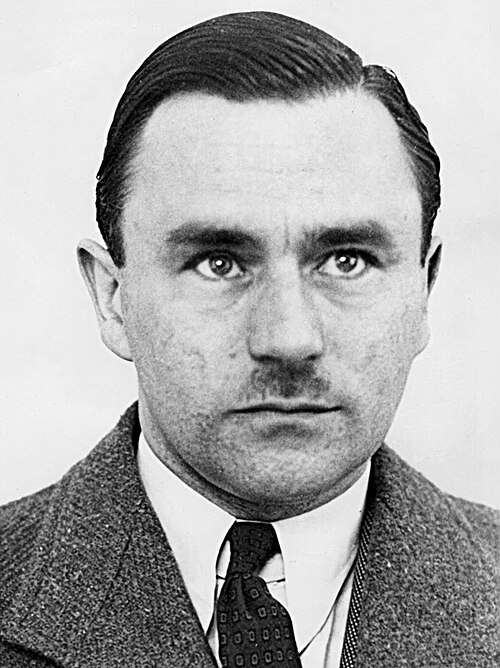
John George Haigh was an English serial killer who battered or shot his victims, then dissolved their bodies in sulphuric acid to erase all evidence. He forged his victims' signatures to sell their possessions and collect large sums of money, a scheme he had refined through years of fraud and multiple prison terms. Though convicted of six murders, Haigh claimed to have killed nine.

Born in Stamford, Lincolnshire, and raised in Yorkshire by strict Plymouth Brethren parents, Haigh drifted from fraud into murder after becoming fascinated by French killer Georges-Alexandre Sarret, who had used acid to dispose of bodies. He was arrested in 1949 after police connected him to the disappearance of a widow whose remains, including gallstones and false teeth, survived the acid and were found at his workshop in Crawley, Sussex. Haigh was convicted at Lewes Assizes and hanged at Wandsworth Prison on 10 August 1949.

Portrait of john george haigh

⬅ See all events from 10 August

Spread the word on your favourite platform!
On This Day in True Crime History
1858·The Rope Broke, So They Hanged Him Again: Samuel Gibbs Executed in Melbourne for the Murder of His Wife
1858·He Named Four Innocent Men as the Killers: Hanged in Melbourne for a Ballarat Murder
1929·She Asked for a Kiss, Then Bled to Death: Frederick Carr Hanged in Adelaide for Murdering His Wife
1963·The Royal Commission That Cleared Brisbane Police, Then Unravelled as a Cover-up
More Crime On This Day →

Subscribe to Dark Stories

True crime stories, dark history and tour news, straight to your inbox.