The unsolved murder of Betty Shanks in 1952 remains one of the most disturbing and enduring cold cases in Australian criminal history. On a quiet September evening in suburban Brisbane, a young woman was violently beaten to death just a few hundred metres from the safety of her parents’ home, and no one has ever been held accountable. Her killing sent shockwaves through a city still settling into peacetime life, and even decades later, it continues to haunt investigators, amateur sleuths, and the people of Brisbane who remember a time when the suburbs felt untouchable by violence. This is the story of Betty Shanks, the investigation that could not solve her murder, and the silence that followed.
Post-War Brisbane and the Quiet Streets of the Inner North
By 1952, Brisbane was a city in transition. The war years had transformed it from a provincial capital into a strategic military hub; American GIs had flooded Fortitude Valley and the CBD, and the social fabric of the city had been stretched and reshaped in ways that lingered long after the troops went home. Peace had returned, but normalcy was still being negotiated. Housing was tight. Families were rebuilding. The suburbs, particularly the leafy inner-north pockets like Wilston and Grange, represented the aspirational heart of that recovery: quiet, respectable, safe.
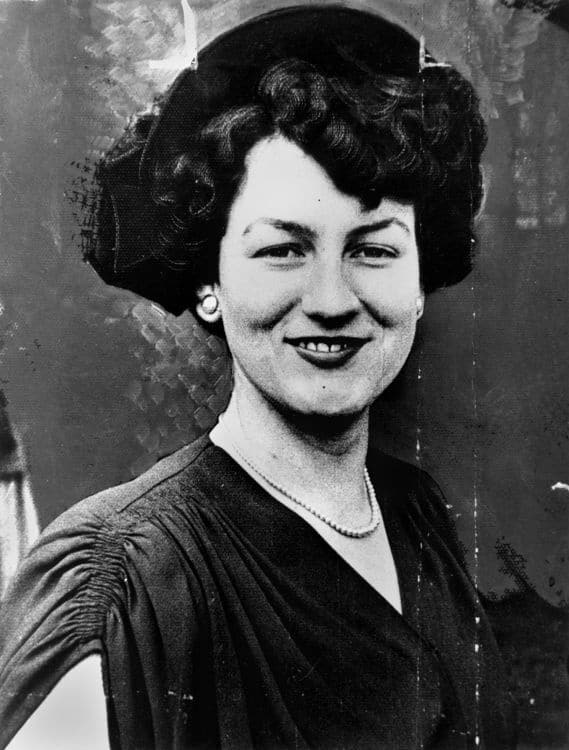
Betty Shanks was 22 years old, a bright and well-liked young woman who worked as a clerk for a Commonwealth Department. She lived with her parents at their home in Grange. By all accounts, she was modest, dependable, and deeply embedded in the rhythms of ordinary suburban life. She caught the tram to work. She came home in the evenings. There was nothing in her routine that should have placed her in danger. And yet, on the night of 19 September 1952, the short walk from the tram terminus at Grange to her parents’ house became the last journey she would ever take.
The Night of 19 September 1952
Betty had been out that evening, attending a night lecture in the Brisbane CBD. After the lecture, she was driven part of the way home by her lecturer, then boarded a tram at Windsor and alighted at the Grange terminus, as she had done countless times before. From there, it was a walk of only a few hundred metres through quiet residential streets to her family home. The route was familiar. The streets were lit, if dimly. The homes she passed were occupied by families she likely recognised. It was an unremarkable journey on an unremarkable night.
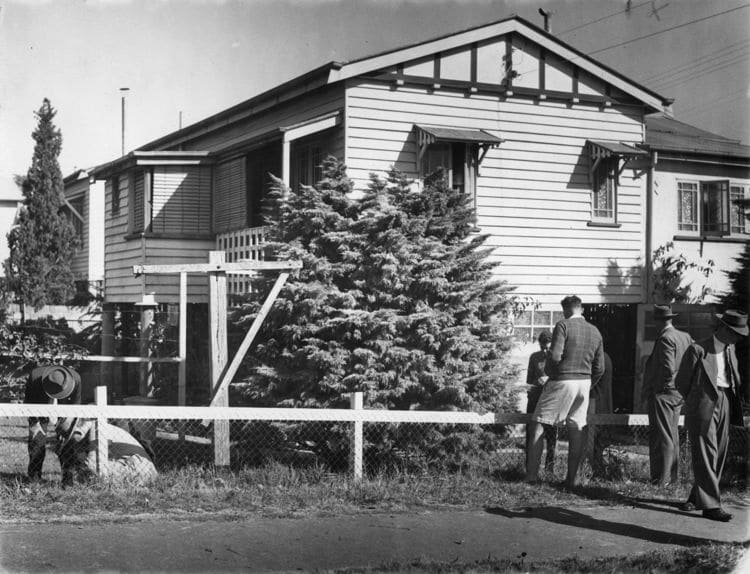
She never made it home. Betty’s body was discovered the following morning in the front garden of a house at the corner of Thomas and Carberry Streets, Grange, just a short distance from her own front door. She had been savagely beaten and kicked, with police finding no evidence of robbery. Her belongings were intact. The motive, like the killer, remained invisible.
The Investigation: Every Lead Gone Cold
Queensland Police launched what was, by the standards of 1952, a significant investigation. Officers canvassed the neighbourhood extensively, interviewing residents of both Grange and Wilston, tram conductors, passengers, and anyone known to have been in the area that evening. The crime scene was examined, though forensic science of the era was limited; there was no DNA analysis, no CCTV, and fingerprint technology was rudimentary at best. Detectives relied on witness testimony, but it was devastatingly scarce.
Several persons of interest were identified in the weeks and months that followed. Among them were men known to Betty through social or professional circles, as well as local figures flagged by neighbours. One name that recurred in community whispers was never substantiated with evidence. Another suspect, a man reportedly seen near the tram terminus that night, could not be conclusively placed at the scene. Each line of inquiry was pursued, and each, in turn, dissolved into ambiguity. No one was ever charged.
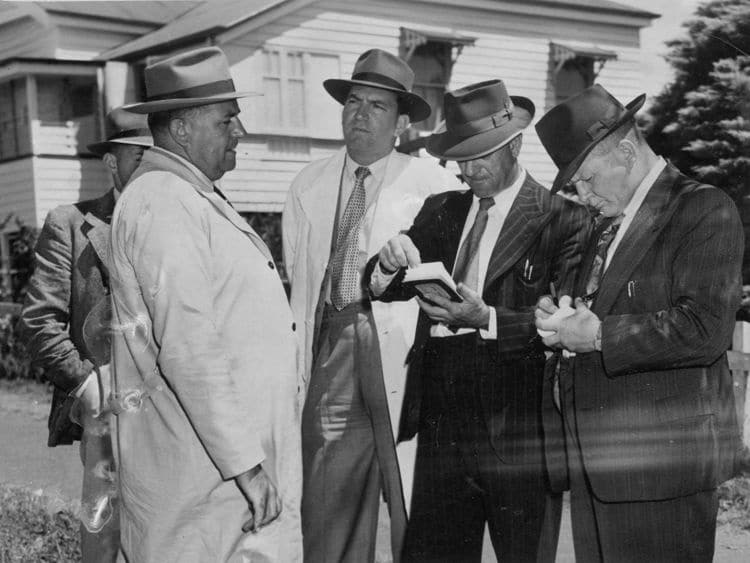
One detail that adds a striking layer of institutional context to this case is the presence of Inspector Frank Bischof at the crime scene. Bischof, photographed during the early investigation, would later become Queensland Police Commissioner and a controversial figure in the history of Queensland policing before the Fitzgerald Inquiry. In the Betty Shanks case, however, his presence is best understood as a historical side note rather than evidence of any particular failing in the investigation.
The Tram Terminus Question
One of the most confounding aspects of Betty Shanks’ murder is its proximity to public space. The Grange tram terminus was not an isolated location. Trams ran regularly. Passengers boarded and alighted throughout the evening. Conductors were present. The surrounding streets, while quiet, were residential and populated. How could a young woman be attacked and killed just metres from a public transport stop, on a route flanked by occupied homes, without a single reliable witness coming forward?
The answer likely lies in the nature of 1950s suburban life after dark. Streets were poorly lit by modern standards. Most residents were indoors by the time Betty alighted from the tram. The attack may have been swift; a sudden ambush from a laneway or garden hedge, carried out by someone who knew her route or who had followed her from the terminus. Sound carries unpredictably in suburban streets, and what might have been heard could easily have been dismissed as a domestic disturbance or an animal. In an era before triple-zero calls and neighbourhood watch programs, the gap between a cry for help and a response could be fatally wide.
The tram angle has been revisited many times. Investigators looked at whether the killer might have been a fellow passenger, someone who rode the same route and followed Betty on foot. They examined whether a tram employee might have known her routine. None of these avenues produced a breakthrough. The tram, which should have been a cocoon of safety delivering Betty to the edge of her own neighbourhood, instead marked the boundary between her life and her death.
Reinvestigations and Cold Case Reviews
Betty Shanks’ case has never been officially closed, and it has been revisited several times by Queensland Police and independent researchers. Cold case reviews in the 1990s and 2000s brought modern forensic techniques to bear on the surviving evidence, though decades of neglect had degraded much of it. DNA technology, which has revolutionised cold case work in Australia and globally, offered limited assistance here; the original crime scene processing did not preserve biological material in ways compatible with later analysis.
Journalists and true crime researchers have combed through witness statements, coronial records, and police files released under freedom-of-information provisions. Each reinvestigation has added texture to the story: new theories about suspects, new readings of the available evidence, and new frustrations at the gaps in the original investigation. Some researchers have pointed to the limitations of 1950s policing culture, in which certain lines of inquiry may have been abandoned prematurely or in which the era’s social dynamics discouraged witnesses from speaking freely.
Despite these efforts, no reinvestigation has produced sufficient evidence to name a suspect, let alone secure a prosecution. The case remains listed among Queensland’s most significant unsolved homicides, a designation that carries both institutional weight and a quiet admission of failure.
Betty’s Family: A Grief Without Resolution
It is easy, after so many years, for a victim to become an abstraction; a name in a case file, a photograph in a newspaper archive, a footnote in the history of Brisbane crime. But Betty Shanks was a real person, with a family who loved her and who lived the rest of their lives in the shadow of her murder. Betty’s parents lost their daughter in the most violent and inexplicable way imaginable, and they never received the closure of knowing who was responsible or why.
Betty’s younger brother carried that burden forward. The Shanks family home, the very place Betty was walking toward when she was killed, became a monument to absence. Every anniversary, every newspaper retrospective, every cold case review reopened the wound without healing it. For families of unsolved murder victims, grief does not follow a linear path; it circles endlessly, caught in the orbit of unanswered questions. Who did this? Why? Were they ever caught for something else? Did they live out their life unpunished, walking the same streets Betty once walked?
The human cost of an unsolved murder extends far beyond the victim. It radiates outward through family, through community, through the collective memory of a city. Betty Shanks deserved justice. Her family deserved answers. Neither has been delivered.
Decades of Silence
As of now, no one has ever been charged with the murder of Betty Shanks. Although various theories and alleged suspects have emerged over the decades, no officially accepted suspect has been identified, no deathbed confession has resolved the case, and no DNA match has materialised. The person who killed Betty on that September night in 1952, only a few hundred metres from her family’s doorstep, either died with their secret or is still alive and extraordinarily old, carrying a truth that no investigator has been able to extract. Decades of silence. That silence is not peace; it is its own kind of horror. It is the sound of a case that was never closed, a family that was never given answers, and a city that has never quite forgotten the night a young woman stepped off a tram at Grange and vanished into violence.
This article is part of the Dark Stories series profiling Australia’s most infamous criminals, unsolved cases, and the darkest chapters of the nation’s history, presented in no particular order. From suburban murders to organised crime empires, from colonial atrocities to modern-day mysteries, we are building an archive of the cases that shaped Australia’s relationship with crime and justice. One day, we will rank them: the most shocking, the most consequential, the most haunting. Until then, we keep telling the stories that deserve to be remembered, because forgetting is its own form of injustice.