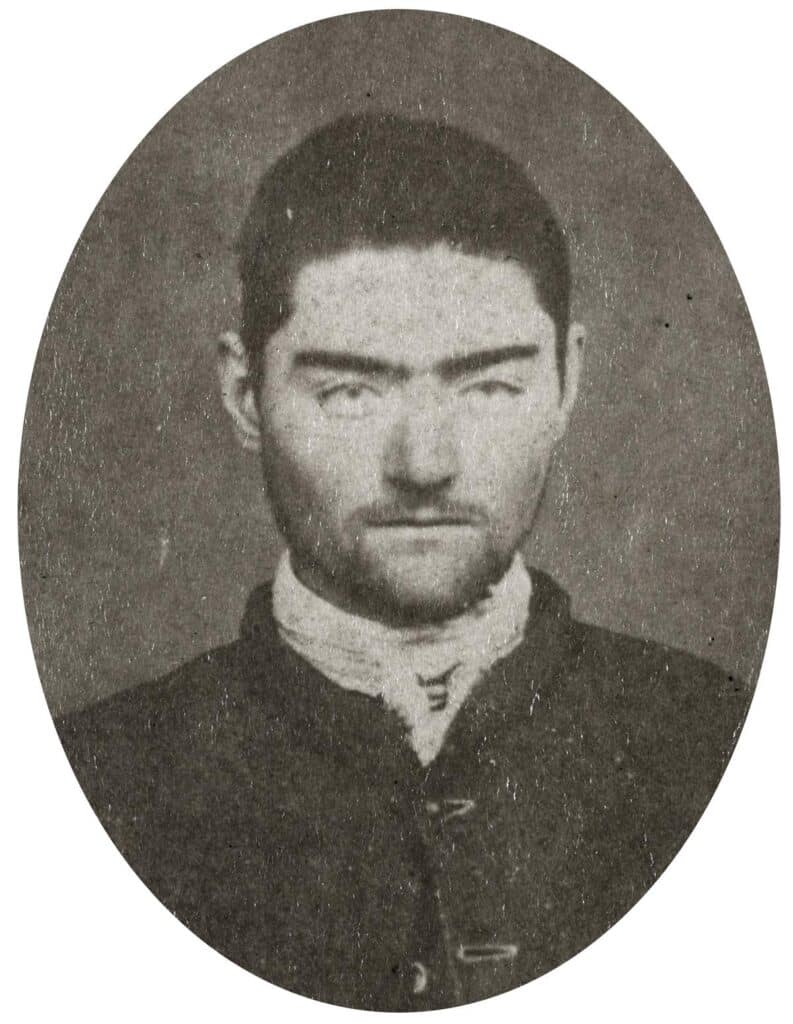
Few names echo through the corridors of Australian criminal history with as much thunder as Ned Kelly. Bushranger, outlaw, cop killer, folk hero: the man who strapped on a suit of homemade armour and walked into a hail of police bullets has become the most debated figure in the nation’s past. Was he a ruthless criminal who terrorised the colonial frontier, or a symbol of Irish resistance against an unjust system? More than 140 years after his execution, the argument rages on. What remains beyond dispute is that Ned Kelly’s story is drenched in blood, betrayal, and a kind of reckless defiance that Australians have never been able to forget.
Born Into Trouble
Edward ‘Ned’ Kelly was born between Dec 1854 and June 1855 in Beveridge, Victoria, the son of John ‘Red’ Kelly, an Irish ex-convict who had been transported to Van Diemen’s Land for stealing two pigs. From the moment he drew his first breath, Ned was marked. The Kelly family lived on the margins: poor selectors in the bush northeast of Melbourne, surrounded by other Irish Catholic families who nursed a bitter distrust of the colonial police. The constabulary, for its part, viewed the Kellys and their kin as little more than a breeding ground for stock thieves and troublemakers.
Red Kelly drank himself into an early grave, dying when Ned was just twelve. The loss devastated the family and thrust young Ned into the role of provider. By his mid-teens he had already been arrested multiple times. He served time for assault and for receiving a stolen horse, a conviction he always insisted was a set-up. The police kept a close and hostile watch on the Kelly household, and Ned’s resentment of authority curdled into something hard and dangerous.
The Fitzpatrick Incident and the Road to Outlawry
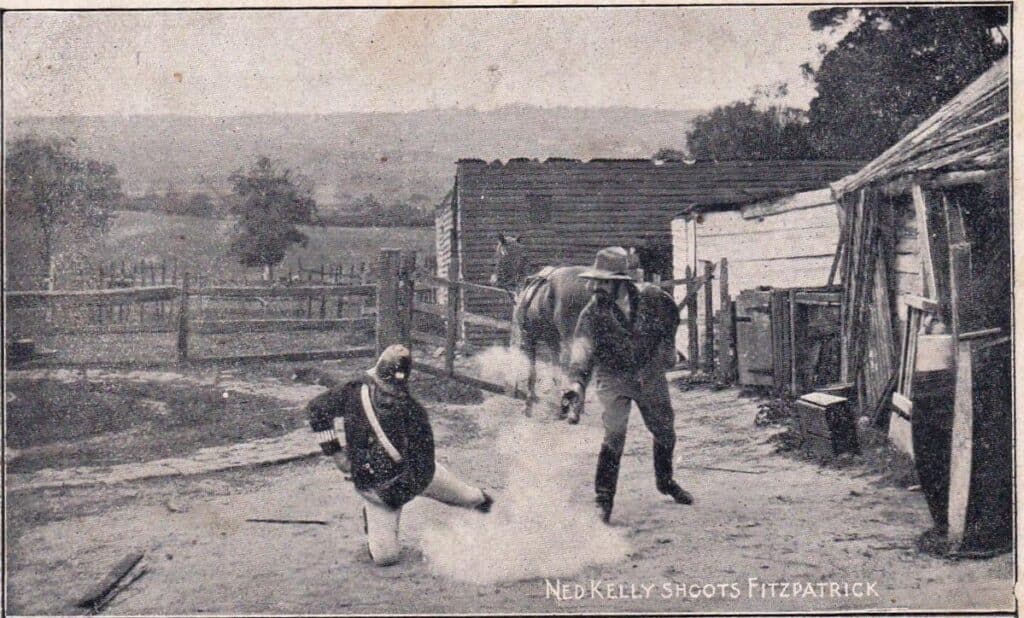
The spark that ignited the Kelly outbreak came in April 1878 when Constable Alexander Fitzpatrick rode out to the Kelly homestead to arrest Ned’s brother Dan on a charge of horse stealing. What happened next depends entirely on who you believe. Fitzpatrick claimed that Ned shot him in the wrist and that the Kelly women attacked him. The Kellys insisted Fitzpatrick was drunk, that he had made improper advances toward Ned’s sister Kate, and that the whole story was fabricated. Regardless of the truth, the consequences were devastating. Ned’s mother Ellen was arrested and sentenced to three years of hard labour for aiding in an attempted murder. Ned, furious and now a wanted man, fled into the Wombat Ranges with Dan and two mates: Joe Byrne and Steve Hart. The Kelly Gang was born.
The quartet hid out in the dense bush, surviving on their wits and the support of a network of sympathisers known as the ‘bush telegraph.’ The police, determined to bring them in, dispatched a party of four officers into the ranges. On 26 October 1878, the constables made camp at Stringybark Creek. They never imagined that the hunters were about to become the hunted.
Stringybark Creek: Blood in the Bush
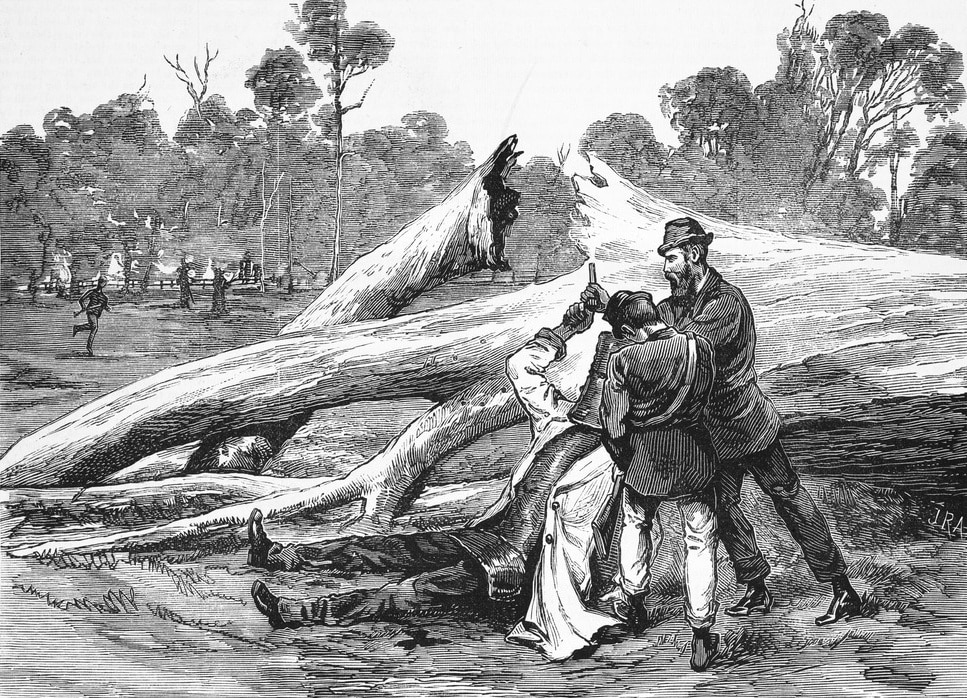
The killings at Stringybark Creek transformed the Kelly Gang from petty fugitives into Australia’s most wanted men. Ned and his companions stumbled upon the police camp and decided to take the officers by surprise. Constables Thomas Lonigan and Michael Scanlan were shot dead. Sergeant Michael Kennedy, who tried to flee into the scrub, was hunted down and killed as well. Only Constable Thomas McIntyre escaped, sprinting through the bush to raise the alarm. Three police officers lay dead in the Victorian bush, and the colony erupted in outrage and fear.
Ned later claimed the killings were self-defence, that the police had come to shoot him on sight. He pointed to the firearms the constables carried and to rumoured ‘body straps’ that he said proved they intended to bring back corpses rather than prisoners. Historians have debated this ever since. Whatever the truth, the government responded with fury, placing a record reward on the gang’s heads and passing the Felons Apprehension Act, which declared them outlaws who could be shot on sight by any citizen.
Euroa and Jerilderie: Audacity on a Grand Scale
Rather than flee the colony, the Kelly Gang doubled down. In December 1878, they held up the National Bank at Euroa, locking hostages in a nearby station while they calmly robbed the vault. In February 1879, they struck again at Jerilderie in New South Wales, this time locking up the local police, donning their uniforms, and parading through the town before robbing the Bank of New South Wales. During the Jerilderie raid, Ned dictated what became known as the Jerilderie Letter: a sprawling, passionate, semi-literate document that railed against police persecution, defended his family’s honour, and threatened dire consequences for anyone who stood against the poor Irish selectors of the northeast.
The Jerilderie Letter is one of the most extraordinary documents in Australian history. Part manifesto, part confession, part threat, it reveals Ned Kelly as something far more complex than a common thief. He wrote of systemic injustice, of families torn apart by poverty and police corruption, of a colonial system that ground the poor into the dirt while rewarding the wealthy. Whether you see it as the ravings of a killer or the cry of an oppressed man, the letter ensured that Ned Kelly would never be viewed as just another bushranger.
The Armour and the Last Stand at Glenrowan
After Jerilderie, the gang went to ground. For over a year they evaded capture, supported by sympathisers and hidden by the vast landscape of the northeast. During this time, Ned conceived his most audacious plan yet. Word had reached him that a heavily armed police party was being mobilised to hunt them down once and for all. Rather than wait to be cornered, he would strike first: lure the police train into a trap at the small town of Glenrowan, derail it on torn-up tracks, and eliminate the threat before it could reach them. It was a preemptive ambush born of desperation and cold calculation.
To prepare for the inevitable confrontation, the gang forged suits of armour from stolen plough mouldboards. The helmets, breastplates, and back plates weighed around 44 kilograms each and could deflect bullets. They were crude, medieval, and utterly iconic. Nothing like them had ever been seen in Australia, and nothing like them would ever be seen again.
On the night of 27 June 1880, the gang took over the Glenrowan Inn and held dozens of hostages. They had torn up the railway tracks outside town. But the plan unravelled when schoolteacher Thomas Curnow, one of the hostages, managed to slip away and flag down the approaching police train with a candle and a red scarf. The train screeched to a halt. The police surrounded the inn. And one of the most dramatic sieges in Australian history began.
Gunfire crackled through the cold winter darkness for hours. Inside, the gang fought back. Joe Byrne was hit and killed while drinking at the bar. Steve Hart and Dan Kelly retreated deeper into the building. Then, as dawn broke, a figure emerged from the mist behind the police lines. It was Ned Kelly, clad head to toe in his suit of iron, firing his revolver with eerie calm. Bullets pinged off his armour as the stunned police scrambled to understand what they were facing. For a few surreal minutes, it seemed as though Ned Kelly was invincible.
But he was not. His legs, unprotected by the armour, were riddled with bullets. A shotgun blast brought him crashing to the ground. Police swarmed over him and dragged away the helmet to reveal a bearded, bloodied face. Ned Kelly was captured alive. Inside the inn, the siege ended in flames. The building was set alight, and the charred remains of Dan Kelly and Steve Hart were pulled from the wreckage. The Kelly Gang was finished.
Trial, Execution, and the Words That Would Not Die
Ned Kelly was tried for the murder of Constable Lonigan at the Melbourne Supreme Court in October 1880. The trial lasted just two days. Despite a spirited defence, the verdict was never in doubt: guilty. Justice Redmond Barry sentenced him to death by hanging. In one of Australian history’s most quoted exchanges, Barry told Kelly, ‘May the Lord have mercy on your soul,’ to which Ned reportedly replied, ‘I will go a little further than that, and say I will see you there where I go.’ Redmond Barry died of natural causes just twelve days after Kelly’s execution; to the superstitious and the sympathetic alike, it felt like prophecy fulfilled.
On 11 November 1880, Ned Kelly was hanged at the Old Melbourne Gaol. He was just 25 years old. His reputed last words have become the stuff of legend: ‘Such is life.’ Whether he actually said them or not, the phrase captured something essential about the man and his story: a shrug in the face of fate, a refusal to beg, a final act of defiance that would resonate for generations.
Legacy: Hero, Villain, or Something Else Entirely
Ned Kelly’s legacy is a battleground. To some, he was a murderer who killed three police officers, terrorised communities, and brought misery to anyone caught in his path. To others, he was a freedom fighter, a product of systemic injustice who dared to stand against the colonial establishment. The truth, as always, is more complicated than either camp would like to admit.
What is undeniable is Kelly’s impact on Australian culture. He has been the subject of the world’s first feature-length narrative film, ‘The Story of the Kelly Gang,’ released in 1906. He has inspired paintings by Sidney Nolan, novels by Peter Carey, and countless songs, plays, and television series. His armour sits in the State Library of Victoria, one of the most visited artefacts in the country. In a nation that has always harboured a soft spot for the underdog, Ned Kelly remains the ultimate anti-hero.
But beneath the mythology lie real victims: Lonigan, Scanlan, and Kennedy, officers who left behind wives and children; Aaron Sherritt, the gang’s one-time friend, murdered by Joe Byrne for allegedly informing; and the dozens of hostages at Glenrowan who spent a terrifying night not knowing whether they would live or die. Any honest reckoning with Ned Kelly must account for their suffering as well as his.
The story of Ned Kelly is, at its core, a story about power: who wields it, who suffers under it, and what happens when someone decides they have had enough. It is a story that Australia keeps telling itself because it has never quite figured out the moral. And perhaps that is the point. Some stories are not meant to be resolved. They are meant to haunt.
This article is part of the Dark Stories series profiling Australia’s most infamous criminals in no particular order. From bushrangers to backpacker killers, each profile peels back the layers of a case that shaped the nation’s darkest chapters. One day, we will do what no one has dared: rank these criminals once and for all, from the merely notorious to the truly monstrous. Until then, the rogues’ gallery keeps growing, and the stories keep getting darker.