John Meff was a housebreaker who had already cheated the gallows once, having been convicted and then transported to the colonies rather than executed. But transportation was meant to be permanent exile, and Meff broke its terms by making his way back to England, a crime that under the law of the day carried the same penalty as the original offence: death.
He was arrested, tried, and sentenced to hang for illegally returning from transportation. On 11 September 1721 he was taken to Tyburn and executed at the age of forty, going to the gallows alongside James Redding, who had been condemned separately for robbery.
For Meff the return to Tyburn marked the end of a second chance he could not keep: having once escaped the noose through transportation, the simple act of coming home proved fatal.
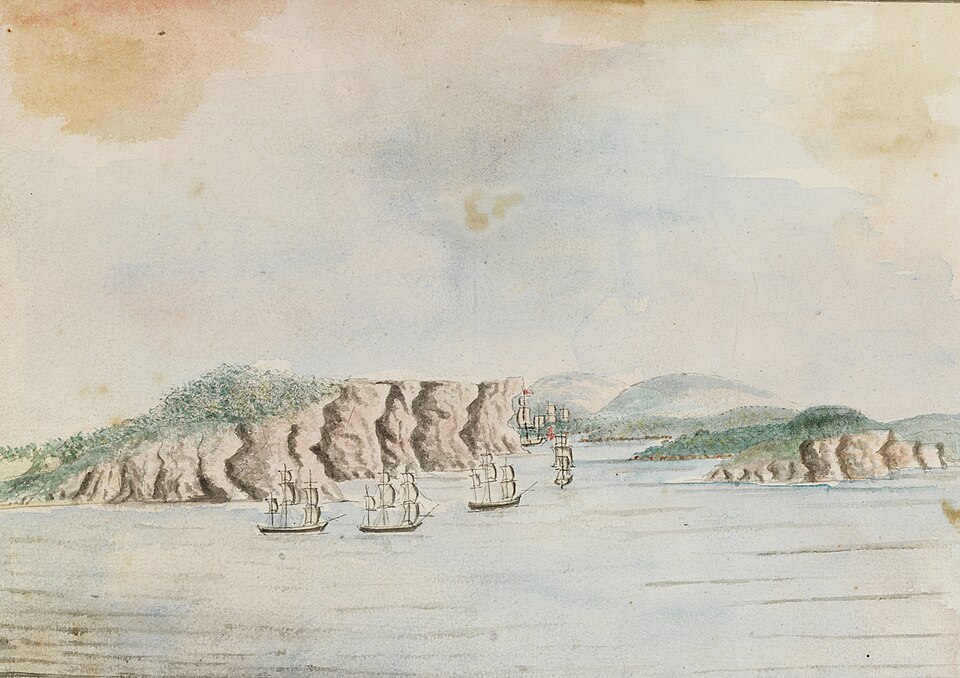
In 1786, Britain faced a crisis of its own making. Decades of the so-called bloody code had swollen the criminal class with petty offenders, American independence had slammed shut the old dumping ground of the colonial plantations, and the gaols were bursting. The solution settled upon was audacious: ship Britain’s unwanted more than 15,000 miles to New South Wales, a coastline only recently mapped by Captain Cook, who had praised the land around Botany Bay.
Over the next 80 years, more than 160,000 men and women were transported to Australia and Van Diemen’s Land. Transportation meant total erasure: the loss of home, family, and identity, followed by a brutal sea crossing and survival in an utterly foreign land. Yet for many, the far side of the world offered something the old country never would: a second chance.
First Fleet ships entering Sydney Harbour 1788 illustration
John Meff is the son of French Protestant refugees who fled persecution under Louis XIV, raised in London with great care and bound apprentice to a weaver. He serves faithfully, marries, and then finds himself unable to keep his family alive on honest wages; it is poverty, not wickedness, that first pushes him toward housebreaking, a trajectory recorded in Lives of the Most Remarkable Criminals with the unsentimental clarity that makes it one of the earliest works of true crime writing we possess.
What follows is a life of compounding misfortune: narrow escapes, broken resolutions, and a restless drift across oceans that never quite carries Meff far enough from the world he is trying to leave behind. His story belongs to a London where the line between desperation and damnation is thinner than anyone cares to admit.
Every road Meff walks seems to curve back toward the same dark gravity, and the law of Georgian England is not a patient institution. Lives of the Most Remarkable Criminals holds the full account; hear it now, read aloud in all its grim detail.
Click the RSS feed link below to subscribe and get new episodes the moment they drop.
Subscribe via RSS
Dark Lexicon: Old words. Dark meaning.
The past speaks its own dialect; here is what to listen for in this episode.
Transported: in modern usage this word simply means moved from one place to another, but in eighteenth century criminal law it carried a very specific and dreaded meaning. To be transported was to be shipped to the colonies as punishment, forced into years of hard labour far from home. It was considered a mercy compared to hanging, though those who endured it might have disagreed.
Marooned: today this word is used loosely to mean stranded anywhere, but its origin is steeped in pirate custom. To be marooned was to be deliberately abandoned on an uninhabited island, usually with little or no provisions; it was a death sentence disguised as exile, a punishment pirates inflicted on those who refused to join their crew or who broke their code.
Springes: a word now almost entirely extinct. A springe was a snare or trap for catching birds and small animals, typically made from a loop of cord or wire attached to a bent branch. In this account, the castaways fashion them from the horsehair of an old wig; desperation breeds invention.
Fluxes: in the eighteenth century a flux was a violent and often fatal bout of diarrhoea or dysentery, the kind of illness that could reduce a strong person to helplessness within days. The word had an urgency to it that its modern medical equivalents have lost; aboard ships and on desolate islands, flux killed as readily as fever.
Ill-courses: a polite eighteenth century way of saying a life of crime. The phrase carried a note of moral judgement baked right into it; one did not simply commit crimes, one ‘addicted’ oneself to ill-courses, as though lawbreaking were a sickness of the will.
Impeached: today impeachment belongs almost entirely to political language, but in this period it meant something closer to informing on or betraying one’s accomplices to the authorities. To impeach a fellow criminal was to give evidence against them in exchange for one’s own life; a survival tactic with a very short shelf life.
Act of Indemnity: a parliamentary pardon extended to certain classes of offenders, wiping the slate clean for specific crimes committed before a given date. These acts were political tools as much as legal ones, and whether a particular criminal fell within their scope could be a matter of life and death; in Meff’s case, the question is raised at trial with everything hanging in the balance.
Put in the cart: the condemned were loaded into an open cart and paraded through the streets to the place of execution. The phrase sounds almost mundane, but for the person sitting in that cart, surrounded by crowds, it was the last journey they would ever take.
About This Series
Lives of the Most Remarkable Criminals is one of the earliest works of true crime writing in the English language, nearly 300 years old, covering murderers, thieves, highwaymen, forgers, coiners and worse.
The book is entirely in the public domain and every word of it can be read today for free. But if you would rather listen, this podcast does exactly that: one criminal at a time, every week, read aloud.
True crime was not invented by podcasts or streaming services. Eighteenth century readers were just as fascinated by outlaws and killers as we are today. They just consumed their dark stories by candlelight.
The voice you hear is David Dark: crime researcher, theatre script writer, producer of live immersive experiences, and audiobook narrator and voice artist. This podcast uses an AI voice model trained on David’s own voice, built using the maximum available training data to faithfully represent how he actually sounds. To hear David’s real voice in human generated form, visit him on Audible, Online Stage, Voices of Today, Spoken Realms, and Internet Archive.
Robert Perkins grows up in Hertfordshire as the son of a prosperous innkeeper, but prosperity does not protect him. After his mother dies and his father remarries, the boy is cast out of his own home; stripped of affection, stripped of inheritance, stripped of everything that might have held him steady.
As recorded in Lives of the Most Remarkable Criminals, Perkins drifts into the kind of company that haunts the margins of Georgian England: drinkers, gamblers, idlers whose appetites outrun their means. His is the sort of true crime story that begins not with malice but with dispossession; a young man living as though he still possessed his father’s fortune while owning almost nothing at all.
What follows is a life pulled further and further from solid ground, carried across oceans and through the gears of a justice system that does not forget. Listen now as Lives of the Most Remarkable Criminals delivers this restless and melancholy account in full.
Click the RSS feed link below to subscribe and get new episodes the moment they drop.
Subscribe via RSS
Dark Lexicon: Old words. Dark meaning.
The past speaks its own dialect; here is what to listen for in this episode.
Mother-in-law: today this means your spouse’s mother, but in the eighteenth century it was the standard term for a stepmother. When the text says Perkins’s mother-in-law had him turned out of the house, it means his father’s new wife; not some distant relative by marriage, but the very woman who replaced his mother under the same roof.
Groat: a small silver coin worth fourpence. To say someone was ‘never a groat the better’ means they gained absolutely nothing; not even the most trivial sum. It was a common way of expressing total exclusion from any benefit or inheritance.
Cast: in legal language of this period, to be ‘cast’ meant to be found guilty at trial. It sounds almost casual to modern ears, like being tossed aside; and in a sense it was exactly that, the court casting you out of ordinary life and into the hands of punishment.
Upon the rake: to go ‘upon the rake’ meant to go out carousing; drinking, gambling, chasing trouble through the streets. A ‘rake’ was a dissolute young man, and the phrase captures the reckless energy of young men looking for anything but honest work.
Shuffle-board: not quite the gentle cruise-ship game of today. In Georgian alehouses, shuffleboard was a tavern pastime played on long wooden tables, and it was closely associated with gambling, idleness, and the kind of company that led to worse things.
Crown piece: a large silver coin worth five shillings. In this account, the alehouse owners had marked a crown with particular scratches or notches so it could be identified if stolen from the till; a trap that snapped shut on Perkins.
Transportation: the sentence of being shipped to the colonies as forced labour. It sounds almost merciful compared to the gallows, but in practice it meant being sold to a planter and worked in conditions little different from enslavement; and returning without permission was a capital offence.
Vulgar pleasures: today ‘vulgar’ suggests crude or obscene, but in this context it simply meant common or low; the cheap amusements of ordinary people. Drinking, gaming, skittle-playing: none of it was scandalous on its own, but together these pastimes marked a young man as someone drifting toward ruin.
About This Series
Lives of the Most Remarkable Criminals is one of the earliest works of true crime writing in the English language, nearly 300 years old, covering murderers, thieves, highwaymen, forgers, coiners and worse.
The book is entirely in the public domain and every word of it can be read today for free. But if you would rather listen, this podcast does exactly that: one criminal at a time, every week, read aloud.
True crime was not invented by podcasts or streaming services. Eighteenth century readers were just as fascinated by outlaws and killers as we are today. They just consumed their dark stories by candlelight.
The voice you hear is David Dark: crime researcher, theatre script writer, producer of live immersive experiences, and audiobook narrator and voice artist. This podcast uses an AI voice model trained on David’s own voice, built using the maximum available training data to faithfully represent how he actually sounds. To hear David’s real voice in human generated form, visit him on Audible, Online Stage, Voices of Today, Spoken Realms, and Internet Archive.
Spread the word on your favourite platform!
Subscribe to Dark Stories
True crime stories, dark history and tour news, straight to your inbox.