In September 1866 a boy’s dog began scratching at a rubbish heap near Sussex Street in Sydney, and uncovered a charred, half-roasted human head. Further searching turned up the dismembered chest of a woman, but no other remains were ever found, and no one in the city had reported her missing.

At the inquest a young doctor testified that the head wounds had killed her almost instantly, and that her body had been carefully dissected and burned afterwards, evidently by someone with real anatomical skill, in an apparent effort to destroy any means of identifying her. The jury returned a verdict of wilful murder against a person or persons unknown, and the government posted a reward of two hundred pounds, offering a pardon to any accomplice willing to name the killer.
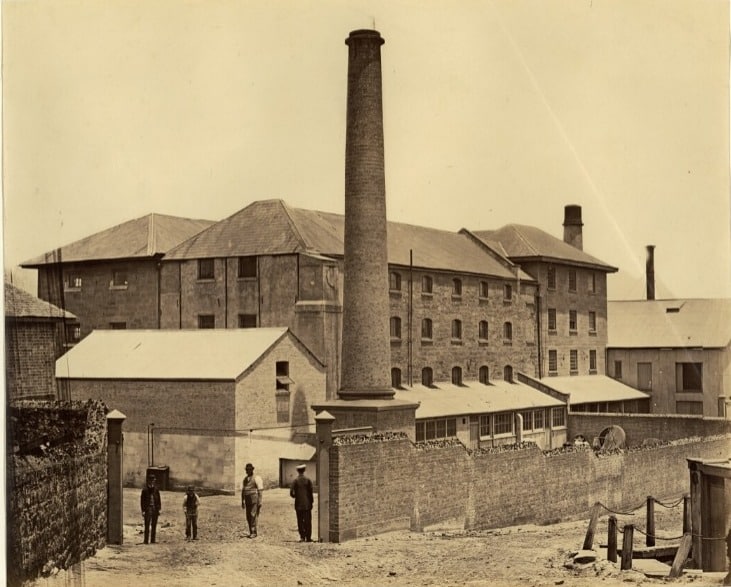

Close to the scene of the crime: Barker & Co. Mills, corner of Sussex and Bathurst Streets, Sydney, before June 1872. Possibly photographed by Charles Pickering. State Library of New South Wales, SPF/484.

⬅ See all events from 2 October

Spread the word on your favourite platform!

Peter Sutcliffe hammered 20 year old Jean Jordan to death near a cemetery in Manchester, then realised the brand new £5 note he had just paid her was traceable straight back to his wage packet. Nine days later he returned in the dark to retrieve it, could not find it, and instead mutilated her body and attempted to cut off her head.

The note had been lying just outside the police search area the whole time, in her handbag under a fence. Detectives traced it to a Bradford pay run and interviewed thousands of workers, including Sutcliffe himself, twice. His alibi held, the inquiry stalled, and the man holding the incriminating fiver walked free for years before he was finally caught as the Yorkshire Ripper.

Piggy bank and new banknotes. Woman holding a piggy bank and new UK five pound notes | ID 82241351 © Peter Titmuss | Dreamstime.com
ID 82241351 © Peter Titmuss | Dreamstime.com

⬅ See all events from 1 October

Spread the word on your favourite platform!

Five men who had run Richard Nixon’s White House and Justice Department went on trial in Washington in October 1974, charged with conspiracy, obstruction of justice and perjury for trying to smother the investigation into the break-in at the Democratic National Committee offices two years earlier.

The trial ran three months. On January 1, 1975, a jury convicted former Attorney General John Mitchell along with chief of staff H.R. Haldeman and aide John Ehrlichman on multiple felony counts; a co-defendant was acquitted. The one man missing from the dock was Nixon himself, who had resigned the previous August and been pardoned by President Gerald Ford before he could ever be charged, leaving the men who had followed his orders to serve the time he never did.

President Richard Nixon made of Wax. Wax figure Richard Nixon reading documents with american flag at desk | ID 59298060 © Lequint | Dreamstime.com
ID 59298060 © Lequint | Dreamstime.com

⬅ See all events from 1 October

Spread the word on your favourite platform!

Patrick Kennedy was a shepherd at an out-station near Penshurst in Victoria, sharing a hut with his wife and two other men. After a night of drinking, he turned on her the next afternoon without any clear provocation, kicking her so violently that the pattern of his boot nails was later found bruised into her body.

He was convicted at the Supreme Court and hanged at Melbourne Gaol on 1 October 1851. The drop failed to kill him instantly, and he struggled for nearly three minutes, prompting the hangman to boast to bystanders that he had predicted exactly how long it would take.

In his final days Kennedy revealed a chilling belief in fatalism, insisting he was merely an instrument of forces beyond his control. He recalled that his small son used to prattle a rhyme, “mammy dead and dady gone,” which he took as a dark omen; when the boy died in custody during his imprisonment, Kennedy said plainly that he was glad.

He showed no remorse for the killing, telling gaolers only, “Drink did it all, but if it had not been done by drink, something else would have done it, as it was decreed to be done.”

Skull and vintage hourglass on wooden background in beam of light

⬅ See all events from 1 October

Spread the word on your favourite platform!
On This Day in True Crime History

Subscribe to Dark Stories

True crime stories, dark history and tour news, straight to your inbox.