On Friday 13th September 1973, 20-year-old David McGreavy was left babysitting the three Ralph children in Worcester while their parents were out. He killed all three.
McGreavy then took a pick-axe to the bodies before impaling the remains on the wrought iron fence spikes of the house next door, where they were discovered by neighbours. The killings, carried out on the date now inseparable from bad luck and horror folklore, later fed the case’s grim nickname as Britain’s real life Friday the 13th murders. McGreavy was convicted and given three life sentences.
Nine week old Azaria Chamberlain vanished from her family’s tent at a campsite near Ayers Rock on the night of 17 August 1980. Her mother, Lindy Chamberlain, said she had seen a dingo leaving the tent, and the baby’s blood stained jumpsuit was found nearby days later, but her body was never recovered. A first inquest in 1981 accepted the dingo account and found no evidence of foul play.
That finding was overturned on appeal, and a second inquest opened on 13 September 1982, reopening a case that had already divided the country. This inquest went the other way, committing Lindy Chamberlain for trial on a charge of murder, a reversal that would send her to prison and make her one of the most publicly vilified women in Australian history.
Lindy Chamberlain was convicted later that year and sentenced to life imprisonment, but the case unravelled in 1986 when a piece of Azaria’s matinee jacket was found near a dingo lair, corroborating the original account. She was released and eventually exonerated, and a fourth inquest in 2012 formally confirmed that a dingo had taken and killed the child.
Aileen Wuornos had already established a deadly pattern along Florida’s highways, targeting men she encountered while working as a sex worker and hitchhiking around the state. Her fifth known victim was a 56-year-old retired police chief. After disappearing, his body was found on September 12 in an isolated area of Marion County. He had been shot seven times in the head and torso with Wuornos’s .22-calibre revolver.
By this stage, Wuornos’s killings had moved well beyond the disputed circumstances surrounding her first victim, Richard Mallory, whose death she maintained had been in self-defence. This latest killing formed part of an escalating pattern that would claim one more victim before police arrested her in January 1991, bringing to an end one of America’s most notorious female serial killing sprees.
Prisoner handcuffed during lethal injection with syringe and vial
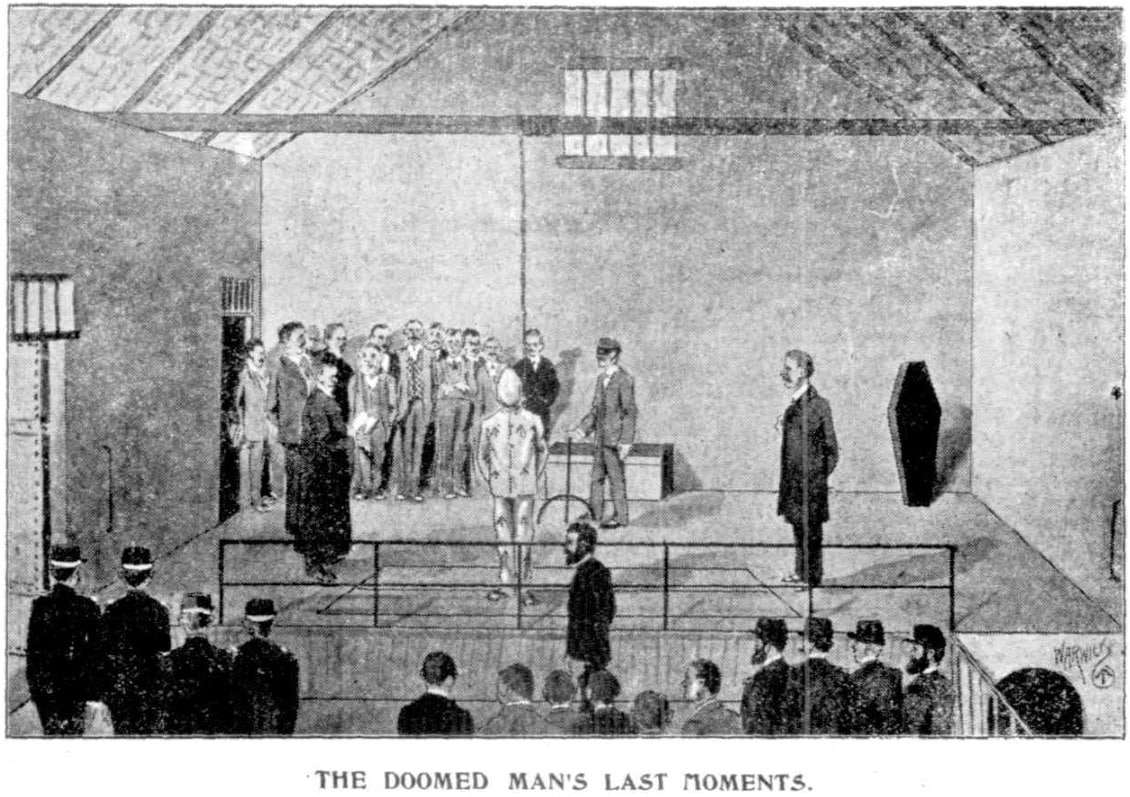
Thomas Bushell, an Imperial convict working in the bake-house at the Convict Establishment in Fremantle, took a 12-inch dough-knife from the bake-house on Sunday 9 July 1865. During the muster of prisoners for church service on C and D landing, he struck warder George Hollis on the head, then stabbed him in the back as Hollis passed, prompting Hollis to cry out, “Secure Bushell, for he has stabbed me.”
At his trial before Chief Justice Burt on 6 September 1865, the wounded warder himself testified that he did not believe Bushell had meant to kill him. The jury convicted him anyway of maliciously wounding with intent to murder, and he was sentenced to death and hanged just days after the verdict.