Archives: Dark Stories: On This Day In True Crime History - Page 14
Sixteen-year-old Nancy Wilcox vanished from Holladay, Utah in 1974, one of a string of young women who disappeared across the state that year without a trace. No body was ever found, no arrest followed, and for years her family had only questions.
The answer came from Ted Bundy himself. Awaiting execution years later, he confessed to her murder as part of a wider accounting of his crimes, admitting to a killing police had never been able to solve. Her remains have still never been recovered.
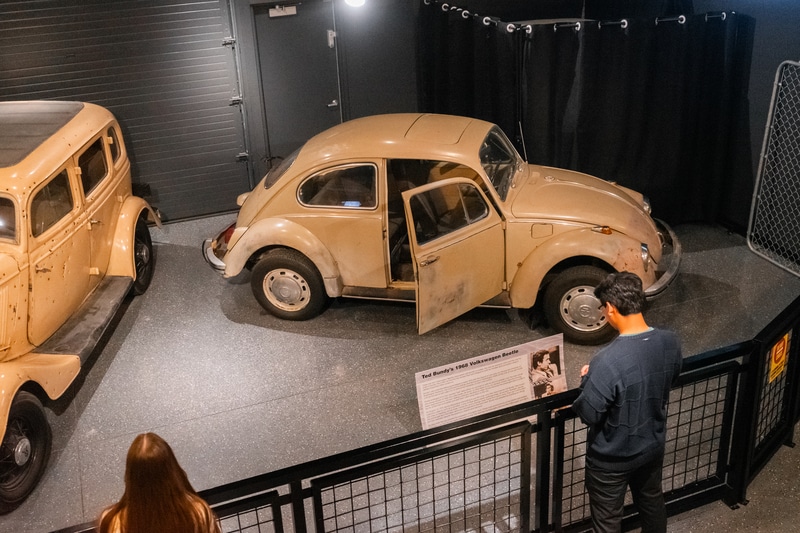
Carol DaRonch had already escaped once. In 1974 a man posing as a police officer lured her to his car, snapped a handcuff on her wrist and tried to force her into it; she fought free, leapt from the moving vehicle and ran.
Months later she stood in a police lineup with two other women and picked out the same face: Ted Bundy. He was arrested and charged with her attempted kidnapping, denied any wrongdoing, and waived his right to a jury trial, gambling that a judge alone would be less swayed by the growing suspicion linking him to a string of disappearances across several states.
DaRonch’s escape and her identification became one of the threads that eventually unravelled Bundy’s double life, feeding directly into the case that first put him behind bars.
On Warland’s Range near Murrurundi in April 1863, a masked rider named Henry Wilson held up a party of drovers and stripped young Peter Clarke of his watch and chain. When Clarke lunged at him, Wilson shot him three times; Clarke was dead within minutes. So furious was the crowd that gathered at the scene that police had to physically stop them from hanging Wilson on the nearest tree.
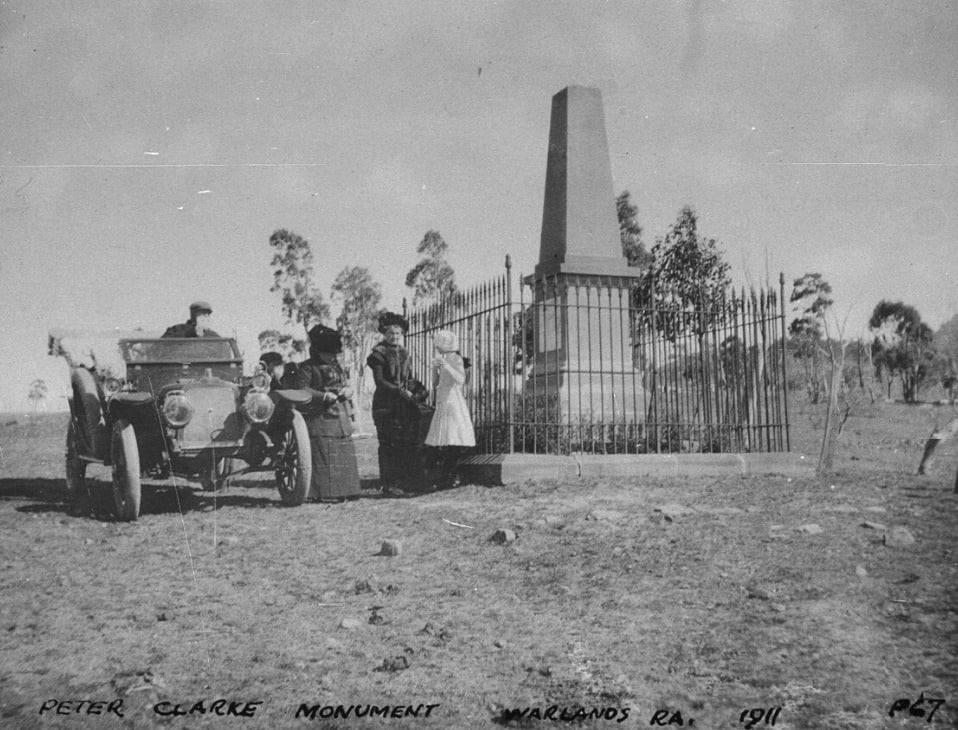
He was tried instead at Maitland Circuit Court, where his counsel argued the fatal shot had gone off accidentally in the struggle. The jury took ten minutes to convict him, and he was hanged at East Maitland Gaol on 2 October 1863. Clarke’s bravery was later honoured with a public monument erected on the spot where he fell.
Wilson admitted firing the shots but denied meaning to kill, blaming drink and panic in the scuffle; still, he told his priest he accepted the justice of his sentence and deserved to die.
Peter Clarke monument, Warland’s Range, near Blandford, NSW. Mitchell Library, State Library of New South Wales, At Work and Play – 05492.
Patrick Kennedy was a shepherd at an out-station near Penshurst in Victoria, sharing a hut with his wife and two other men. After a night of drinking, he turned on her the next afternoon without any clear provocation, kicking her so violently that the pattern of his boot nails was later found bruised into her body.
He was convicted at the Supreme Court and hanged at Melbourne Gaol on 1 October 1851. The drop failed to kill him instantly, and he struggled for nearly three minutes, prompting the hangman to boast to bystanders that he had predicted exactly how long it would take.
In his final days Kennedy revealed a chilling belief in fatalism, insisting he was merely an instrument of forces beyond his control. He recalled that his small son used to prattle a rhyme, “mammy dead and dady gone,” which he took as a dark omen; when the boy died in custody during his imprisonment, Kennedy said plainly that he was glad.
He showed no remorse for the killing, telling gaolers only, “Drink did it all, but if it had not been done by drink, something else would have done it, as it was decreed to be done.”
Skull and vintage hourglass on wooden background in beam of light