1969: The Zodiac Killer Leaves His Own Scorecard Written on a Victim’s Car Door

On September 27, 1969, at about 6.30 pm, the Zodiac Killer attacked Bryan Hartnell, 20, and Cecelia Shepard, 22, as they picnicked at Lake Berryessa in Napa County, California. He wore a black hooded costume marked with his crosshair symbol and, breaking from the shootings of his earlier attacks, stabbed both victims repeatedly. Hartnell survived; Shepard died two days later.

Before leaving, the killer used a black felt-tip pen to draw his crosshair signature on Hartnell’s car door, then listed beneath it the dates and locations of his previous attacks: Vallejo, 12-20-68, 7-4-69, and the day’s own assault, 6:30, by knife. The first date referred to the killing of David Faraday, 17, and Betty Lou Jensen, 16, on Lake Herman Road, and the second to the shooting of Michael Mageau, 19, and Darlene Ferrin, 22, in a Vallejo park, where Mageau survived and Ferrin died.

The note tied all three attacks together in the killer’s own hand at the scene, before any letter to police or press had been sent. He then drove roughly 27 miles to a car wash in downtown Napa and, from a payphone, calmly called the Napa County Sheriff’s Department himself at 7.40 pm to report the crime.


Symbolism
Symbolism

⬅ See all events from 27 September

Spread the word on your favourite platform!

1803: The Man They Could Not Hang: Joseph Samuel Survives Three Executions at Sydney

Joseph Samuel was condemned to hang in 1803 for a robbery tied to the murder of Constable Luker in Sydney. On the scaffold, the rope snapped clean in the middle the instant the cart was drawn away, dropping him unconscious to the ground.

Officials dragged his limp body back onto the cart and fitted a second rope, only for it to unravel entirely, lowering him so slowly that his legs trailed on the ground while he half hung there. The assembled crowd was horrified by the spectacle as a third rope was rigged and this one snapped again, close against his neck, as the body was lowered.

With the crowd unnerved and three ropes failed in a row, Governor King, took the repeated failures as a sign of divine intervention and granted Samuel a reprieve. His sentence was commuted to life imprisonment, and he was nursed back to health and eventually to sanity.

After his reprieve, Samuel remained a convict. In April 1806, he made an escape attempt from Newcastle with seven other convicts in a small boat. All were presumed drowned in a storm, less than three years after he had survived three attempts to hang him.

Joseph Samuels hanging attempt rope snaps three times in 1803 Sydney

⬅ See all events from 26 September

Spread the word on your favourite platform!

1892: He Stood at the Roadside as the Body Went By: a Brisbane Teenager Hanged for Murder

Frank Horrocks was barely 17, the son of a senior Queensland civil servant and only a year out of grammar school in Brisbane, when he was charged with murder. As police carted the body of his victim to the morgue, Horrocks was reportedly standing at a road junction, watching it pass.    Rudolph Weissmuller, 20, was a newly arrived immigrant looking for bush work, and Horrocks was the only fellow lodger he confided in. In April 1892 the pair left their boarding house together; only Horrocks came back, and he slipped away that night without paying his board. The body was found in the bush beside a small tomahawk, the twin of one Horrocks had bought the day before. He gave a false name when arrested, which proved useless: the detective sent to collect him had known him since he was a little boy.    Pleas for mercy on the grounds of his youth and unsound mind were refused. Several hundred people, some with infants in their arms, gathered outside the gaol on the morning of the execution. Horrocks had slept soundly and eaten a hearty breakfast, stood “steady as a rock” on the scaffold and never spoke.    On his arrest he had insisted “I did not kill him”, but before the end he sent a confession to the Governor, admitting the deed and the justice of his sentence.

Frank Horrocks Unmoved

⬅ See all events from 26 September

Spread the word on your favourite platform!

1901: President McKinley’s Killer Sentenced to Death After Jury Deliberates Barely an Hour

Leon Czolgosz shot President William McKinley on 6 September 1901 at the Pan-American Exposition in Buffalo, New York, firing two shots from a revolver he had concealed inside a handkerchief. McKinley lingered for eight days before dying of his wounds on 14 September.

Czolgosz’s trial opened on 23 September. The jury took less than an hour to find him guilty, and on 26 September he was sentenced to death. He was executed in the electric chair at Auburn Prison on 29 October 1901, and prison officials later poured acid into his coffin to prevent the grave becoming a shrine.

Czolgosz showed no remorse for the killing. From the scaffold he declared, “I killed the President because he was the enemy of the good people, the good working people. I am not sorry for my crime.”

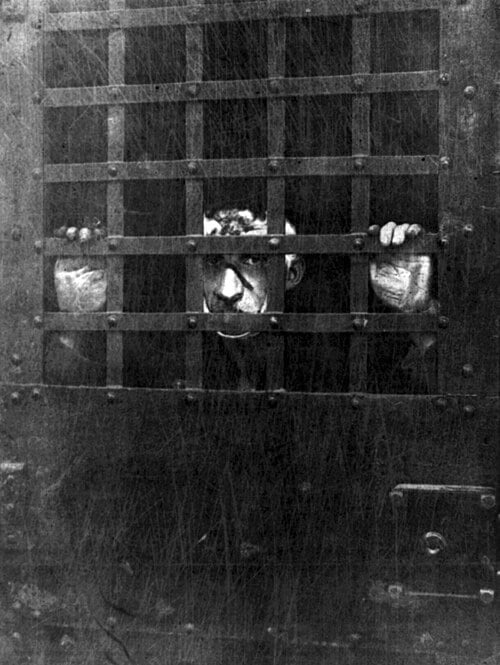
Leon F Czolgosz in Jail

⬅ See all events from 26 September

Spread the word on your favourite platform!
On This Day in True Crime History

Subscribe to Dark Stories

True crime stories, dark history and tour news, straight to your inbox.