Ian Brady insisted that his lover, Myra Hindley, had nothing to do with the killing. But detectives found a handwritten account in her car describing their plan to murder a teenager: a plan they had already carried out.
Further searches uncovered photographs and a tape recording documenting another victim’s ordeal. On the recording, detectives heard not only the pleas for mercy, but the voices of Brady and Hindley themselves.
One October night in 1965, Ian Brady and his lover Myra Hindley brought a seventeen-year-old back to their home near Manchester, where Brady killed him with an axe in front of Hindley's brother-in-law, David Smith, whom they had wrongly taken for a kindIan Brady and Myra Hindley brought 17-year-old Edward Evans back to their home near Manchester after Brady had approached him at Manchester Central station. Brady attacked Evans with a hatchet in front of Hindley's brother-in-law, David Smith, whom Brady apparently believed could be drawn into his criminal world, before strangling Evans with electrical flex.
Smith was horrified and notified police the next morning. Police Superintendent Bob Talbot arrived at the house wearing a bread deliveryman's overall over his uniform. Inside, Brady was lying on a divan writing to his employer about his injured ankle. Talbot said he was investigating "an act of violence involving guns", and Hindley denied that any violence had occurred.
When officers asked for the key to a locked spare bedroom, Hindley claimed it was at work. Police offered to take her there to retrieve it, at which point Brady told her to hand it over. Inside the room, they found Evans's body, and Brady was arrested on suspicion of murder.
Vito 'Socko' Gurino, a trigger man for the Brooklyn-based crime syndicate Murder Inc., was finally cornered on September 12, 1940, not in some underworld hideout but inside the Church of the Guardian Angel in Manhattan, where he had been hiding out from New Jersey. Detectives found him screaming hysterically, convinced his own associates were coming to silence him for good.
The fear was not unfounded. Gurino had spent weeks in fear of his life, aware that Murder Inc. dealt with liabilities by killing them before they could talk to police.
Once in custody, Gurino broke quickly, confessing to three murders carried out on the syndicate's orders and implicating himself in four more killings, opening a window into the machine-like efficiency of contract killing that had terrorised the New York underworld for years.
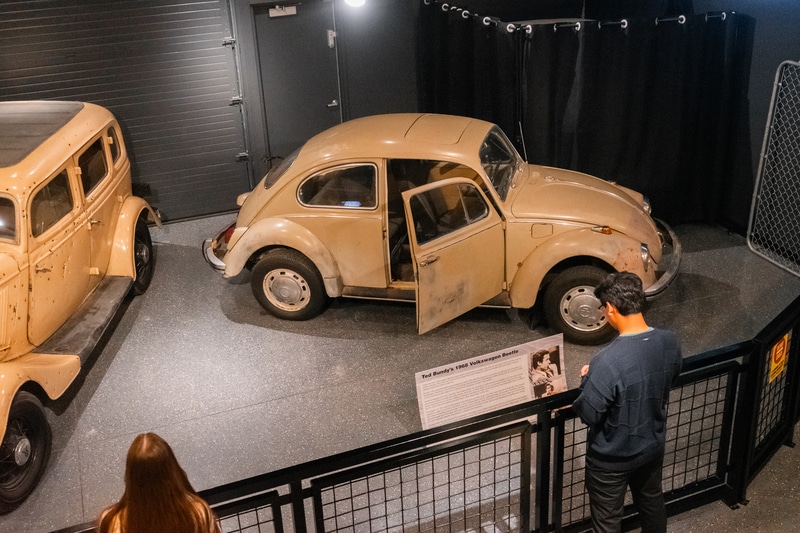
At 3 a.m. on 16 August 1975, Utah Highway Patrol Trooper Bob Hayward took a wrong turn leaving a subdivision and stumbled onto a tan Volkswagen Beetle parked outside a neighbour's home. When his headlights hit the car, it fled, running dark through stop signs. When Hayward finally pulled the driver over, a search of the vehicle turned up handcuffs, an ice pick, a crowbar, and pantyhose with eye holes cut out. The missing front passenger seat only deepened suspicion. The driver was Ted Bundy, law school student, and by then already responsible for the deaths of at least 25 young women across four states.
Bundy was initially arrested for burglary. The items found matched restraints used in the kidnapping of Carol DaRonch, who later identified Bundy in a lineup. He was convicted of her attempted kidnapping. Separately, detectives linked him to the February 1975 murder of Caryn Campbell, a 23-year-old nurse killed in Colorado. Charged with Campbell's murder, Bundy was transferred to a jail in Aspen, Colorado, to stand trial. His girlfriend, Elizabeth Kloepfer, had reported her suspicions to police multiple times in 1974. Nobody had acted. A wrong turn finally changed that.