In August 1963, Perth police discovered a rifle hidden in bushes, linked to the murder of Shirley McLeod. Rather than remove it, they set a trap: replacing the weapon with an inoperable replica tied with fishing line, then waited.
On 1 September 1963, Eric Edgar Cooke returned to retrieve the rifle and was arrested on the spot. Under questioning, he confessed to 22 violent crimes, including eight murders, making him one of the deadliest serial killers in Australian history.
A dispute over the butchering of a pig turned fatal in Hobart in 1825. John Read Riddel, a carpenter, had hired a butcher to cut up a slaughtered pig. Dissatisfied with the work, the two men came to blows, and Riddel drove a knife into the man during the struggle.
Standing on the gallows for his crime, on 31 August 1825, Riddel confessed to the gathered crowd to smothering two of his wives while they slept in a drunken stupor, to forging a letter with an English postmark to deceive a clergyman into marrying him, and to a failed attempt on the life of his Captain, where he had snatched a concealed sword and was about to strike when a bystander intervened.
Riddel himself requested that the full weight of his crimes be made public, before being launched into eternity.
Piggy bank hanging from a hangmans noose on a golden rope
Thomas Peacock, transported from Macquarie Harbour to stand trial, was convicted in the Supreme Court of the murder of Constable Craggs. Craggs had apprehended Peacock in the bush; Peacock stabbed him deliberately in the left side, declaring at the time that he would die happy having caused the constable’s death.
Peacock was hanged on the new drop at Hobart Gaol on 31 August 1825. His loud sobbing on the scaffold suggested the happiness he had claimed was nowhere to be found in his final moments.
On an evening in July 1825, a gang of armed bushrangers descended on the home of Samuel Haywood in the Macquarie district of Van Diemen’s Land. One of the men posed as a letter carrier, tricking Mrs Haywood into opening the door before the others rushed inside. When Haywood moved for his gun, a pistol was fired at him during the confrontation.
The gang ransacked the house and escaped with an immense quantity of property, including clothing. They were later traced to a house near the Hobart Penitentiary, where their brazenness helped betray them: several were still wearing clothes stolen from Haywood and were immediately recognised by their victim.
At the Supreme Court, John Everist, Joseph Broadhead, Charles Bradbury and William Buckley were tried for the robbery. The Attorney-General remarked that almost every crime short of murder had been committed during the raid.
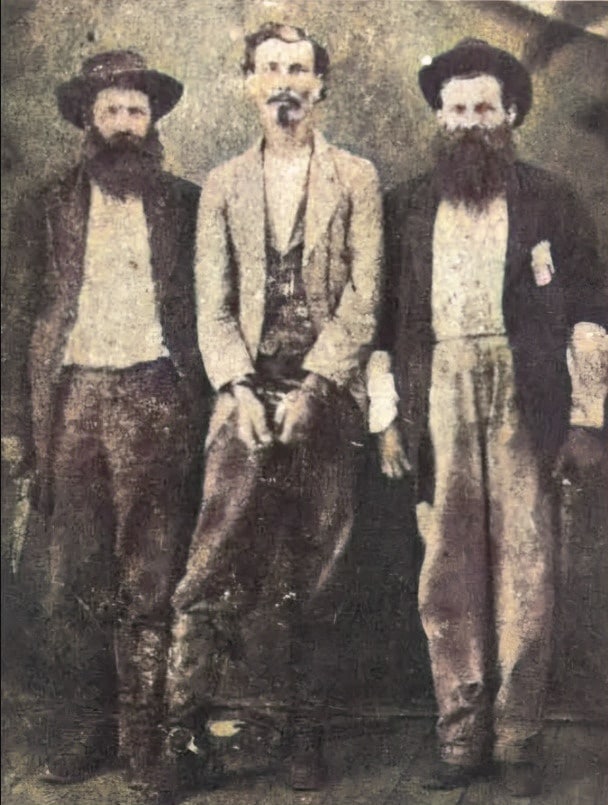
Everist, Broadhead and Buckley were convicted and hanged at Hobart on 31 August 1825.
Three hanging noose ropes isolated on a white background