Archives: Dark Stories: On This Day In True Crime History - Page 75
On 17 August 1960, American pilot Francis Gary Powers stood trial in Moscow after his U-2 reconnaissance aircraft was shot down over Soviet airspace on 1 May 1960. Powers, flying a CIA surveillance mission, had been captured alive when his high-altitude spy plane was struck by a Soviet surface-to-air missile near Sverdlovsk.
Powers pleaded guilty to espionage charges before a Soviet military tribunal, in a trial that became a Cold War spectacle broadcast to the world. He was sentenced to ten years, serving nearly two before being exchanged for Soviet spy Rudolf Abel at the Glienicke Bridge in Berlin in February 1962.
Six-year-old JonBenet Ramsey was found murdered in the basement of her family home in Boulder, Colorado, on 26 December 1996. The case consumed the nation: her parents, John and Patsy Ramsey, endured years of public suspicion, and the mystery deepened further when Patsy died of ovarian cancer in June 2006 without ever being charged.
Just two months after Patsy Ramsey’s death, John Mark Karr was arrested in Bangkok, Thailand, on 16 August 2006, after confessing to the killing. The confession electrified the case. But when DNA testing was conducted, Karr’s profile did not match the unknown male DNA recovered from the crime scene. Charges were dropped, and the murder of JonBenet Ramsey remains officially unsolved.
In August 1992, John Justin Bunting bashed the first of what would become twelve murder victims to death with a hammer at his home in Salisbury North, north of Adelaide. Bunting, a former abattoir worker filled with deep hatred, led a cell of killers that included Robert Joe Wagner and James Vlassakis, operating across South Australia between 1992 and 1999.
The murders became known as the Snowtown or Bodies in Barrels case after eight of the twelve victims were found sealed in acid-filled barrels inside an abandoned bank vault in Snowtown, 140 kilometres north of Adelaide. The trial was among the longest and most publicised in Australian legal history, ending with Bunting and Wagner convicted of multiple murders and Vlassakis, who confessed to four killings and testified for the Crown, receiving a lesser sentence.
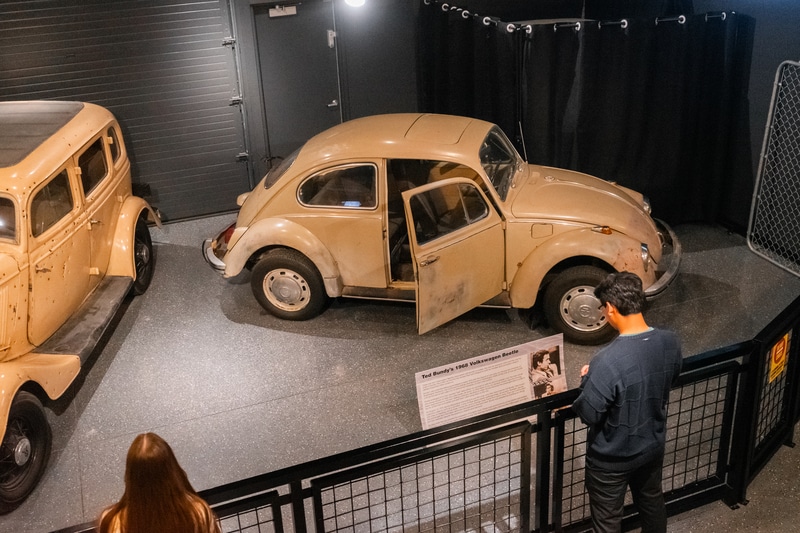
At 3 a.m. on 16 August 1975, Utah Highway Patrol Trooper Bob Hayward took a wrong turn leaving a subdivision and stumbled onto a tan Volkswagen Beetle parked outside a neighbour’s home. When his headlights hit the car, it fled, running dark through stop signs. When Hayward finally pulled the driver over, a search of the vehicle turned up handcuffs, an ice pick, a crowbar, and pantyhose with eye holes cut out. The missing front passenger seat only deepened suspicion. The driver was Ted Bundy, law school student, and by then already responsible for the deaths of at least 25 young women across four states.
Bundy was initially arrested for burglary. The items found matched restraints used in the kidnapping of Carol DaRonch, who later identified Bundy in a lineup. He was convicted of her attempted kidnapping. Separately, detectives linked him to the February 1975 murder of Caryn Campbell, a 23-year-old nurse killed in Colorado. Charged with Campbell’s murder, Bundy was transferred to a jail in Aspen, Colorado, to stand trial. His girlfriend, Elizabeth Kloepfer, had reported her suspicions to police multiple times in 1974. Nobody had acted. A wrong turn finally changed that.