Thomas Woolcock died at 3 am on 4 September 1873 in Moonta, Adelaide having suffered weeks of stomach pains, nausea, and prolonged vomiting. His death was initially attributed to exhaustion, but suspicion quickly fell on his wife Elizabeth Woolcock, a woman whose own life had been marked by hardship, abuse, and desperation.

Elizabeth had endured years of violence at the hands of Woolcock, a heavy-drinking wife-beater who had repeatedly prevented her from leaving. In the weeks before his death, she had made increasingly frantic attempts to obtain morphine and other substances from local chemists, and her behaviour had become talk of the community. Charged with murder by mercury poisoning, Elizabeth was tried, convicted, and hanged at Adelaide Gaol on 30 December 1873. She remains the only woman ever executed in South Australia.
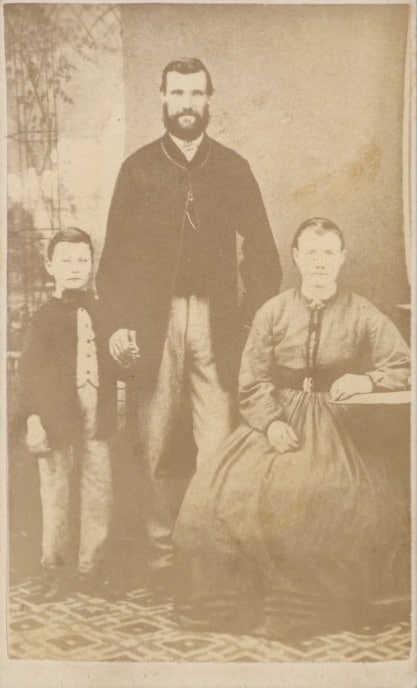

Elizabeth Lillian Woolcock with her husband Thomas and their son Tom, c.1865. State Library of South Australia, B 12311. Public domain.

⬅ See all events from 4 September

Spread the word on your favourite platform!

In September 1939, New York bookmaker Irving Feinstein was strangled to death by members of Murder Inc., the enforcement arm of the American organised crime syndicate. His body was set alight and dumped in a vacant lot, a signature disposal method of the organisation.

The killing was ordered after Feinstein was accused of doublecrossing a criminal associate. He was one of dozens of victims claimed by Murder Inc. during its brutal reign as a contract killing operation for the mob.

Murder Incorporated
Murder Incorporated

⬅ See all events from 4 September

Spread the word on your favourite platform!

On the evening of 3 September 2009, millionaire businessman Michael McGurk was shot dead in the driveway of his home in Cremorne, Sydney. His young son witnessed the killing. McGurk had been embroiled in a bitter legal dispute with property developer Ron Medich over a failed business deal.

The murder triggered one of the most complex organised crime investigations in New South Wales in years. Ron Medich was ultimately convicted in 2019 of arranging the killing, and sentenced to a minimum of 30 years in prison.

Dispute
Dispute

⬅ See all events from 3 September

Spread the word on your favourite platform!

Soviet serial killer Andrei Chikatilo had committed his first murder in 1978, preying on young victims lured from rail stations and bus depots around Rostov-na-Donu. By 1981, after a three-year hiatus that investigators could scarcely explain, he resumed killing. Poverty and the decay of Soviet society made his victims easy to isolate: young people drifting toward cities with no contacts, no money, and no one to report them missing.

Chikatilo would not be caught for nearly another decade. In 1984, police briefly detained him but a botched blood typing test cleared him. He was convicted of theft and served three months. By 1990, when he was finally arrested, he had murdered at least 50 people. Soviet authorities had actively suppressed public warnings during the investigation, maintaining that serial murder was ideologically incompatible with communist society.

Aerial view of Rostov

⬅ See all events from 3 September

Spread the word on your favourite platform!
On This Day in True Crime History

Subscribe to Dark Stories

True crime stories, dark history and tour news, straight to your inbox.