Archives: Dark Stories: On This Day In True Crime History - Page 24
1977: The Last Blade Falls: the Final Guillotine Execution in France
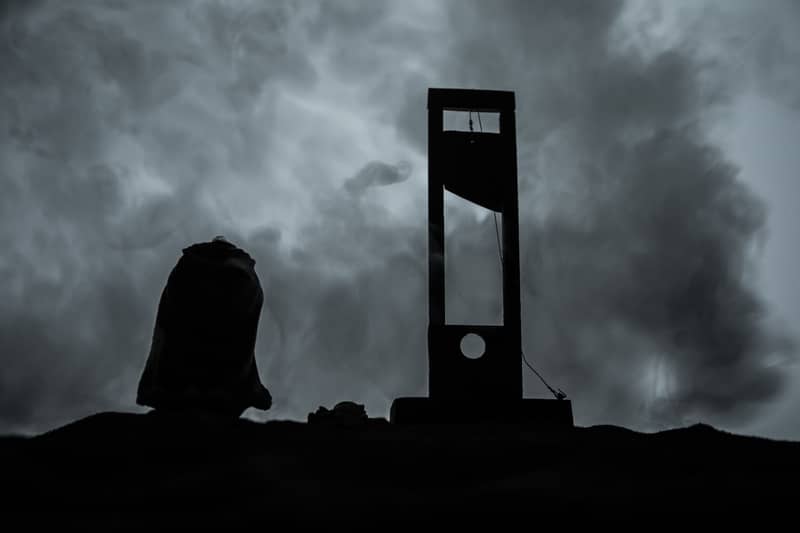
Hamida Djandoubi went to the guillotine in France on this day in 1977, the last person ever executed by the device and the last person executed in France at all. He had been convicted of the murder of 21-year-old Elisabeth Bousquet, a crime that closed out nearly two centuries of the guillotine’s use as the instrument of French justice.
His execution marked a quiet historical hinge: within a few years France would abolish capital punishment altogether, in 1981, making Djandoubi’s death the final chapter of a punishment first adopted during the French Revolution.
Close-up of a guillotine in dark foggy setting execution concept
1996: The Menendez Brothers Split Up: Sent to Separate Maximum-Security Prisons
After their conviction for the 1989 shotgun murders of their parents, Jose and Kitty Menendez, in the family’s Beverly Hills home, the California Department of Corrections classified Lyle and Erik as maximum-security inmates and separated them, ending years of the brothers being held together. Lyle was sent to the California Correctional Institution near Tehachapi, while Erik was sent to California State Prison near Sacramento.
The brothers had initially told police that intruders, possibly connected to organised crime, were responsible for the killings. Suspicion grew after investigators noted their lavish spending in the months following the murders and discovered they had hired a computer expert to delete their father’s recently updated will. Erik ultimately confessed to the killings during sessions with his psychologist, describing a desire to escape a controlling father’s demanding expectations, a disclosure that led to both brothers’ arrests.
John Wayne Glover, 72, was found hanging from a shower rail in his cell at Lithgow prison in New South Wales. He had been serving life without parole for the murder of six elderly women on Sydney‘s North Shore between 1989 and 1990. The mayor of Mosman described his death as the end of a terrible era.
No evidence has ever surfaced that Glover killed before 1989, when he was 56 and had already been married for 20 years with children; his wife had no idea of the violence in his past. He only admitted to the murders once confronted with the police evidence against him.
Glover denied responsibility for other crimes in which he was a prime suspect. Years after his conviction, he admitted he never worried about who his victims were or why he killed them; he said he wanted to stop but could not, and simply returned to his normal life after each murder.
1754: Born to Mutiny Twice: Captain William Bligh, Survivor of the Bounty and the Rum Rebellion in Sydney
Born on 9 September 1754, William Bligh rose to Vice-Admiral of the Blue and served as Governor of New South Wales from 1806 to 1808, but he is remembered above all for surviving not one but two uprisings against his command.
The first came on 28 April 1789 aboard HMAV Bounty, when Master’s Mate Fletcher Christian led a mutiny in the South Pacific. Bligh and 18 loyal crew were cast adrift in a 23-foot open launch so overloaded its gunwales sat only inches above the water, given four cutlasses and barely a week’s food, with a compass and quadrant but no charts. The ship’s clerk, Samuel, defied threats from the mutineers to smuggle aboard vital navigation instruments, while the gunner’s own pocket watch became the only means of keeping time. Fleeing hostile islanders at Tofua, the party lost quartermaster John Norton, killed on the beach, before Bligh navigated the tiny boat some 3,618 nautical miles to safety at Timor.
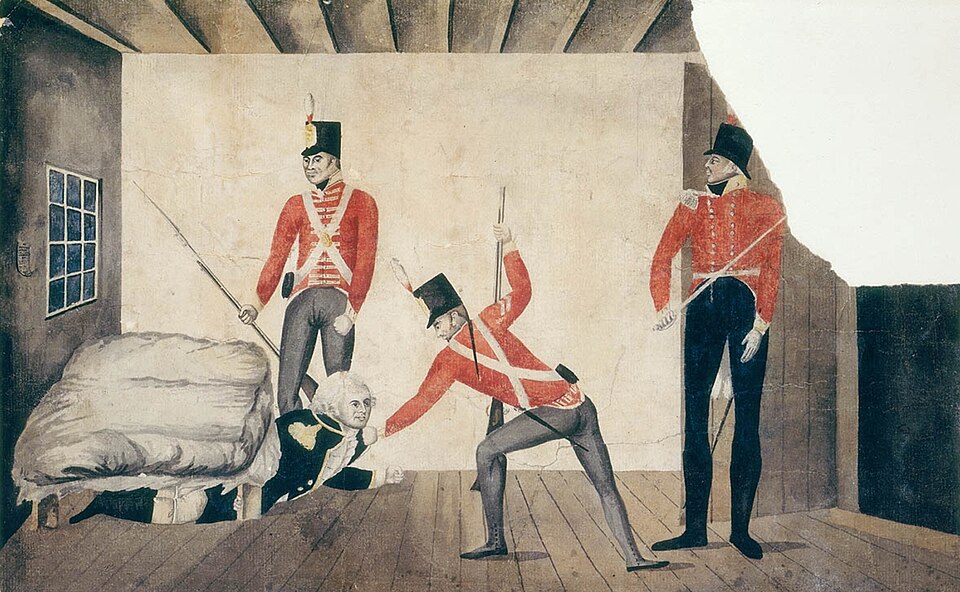
Nearly two decades later, as governor of Sydney, Bligh faced a second rebellion when officers of the NSW Corps deposed him in the colony’s Rum Rebellion, a rare case of a British officer surviving both a shipboard mutiny and a colonial military coup.
Sydney Rum Rebellion Arrest of Governor Bligh historical illustration