1925: Murder On The Dance Floor: Audrey Jacob Shoots Fiance Dead in Perth

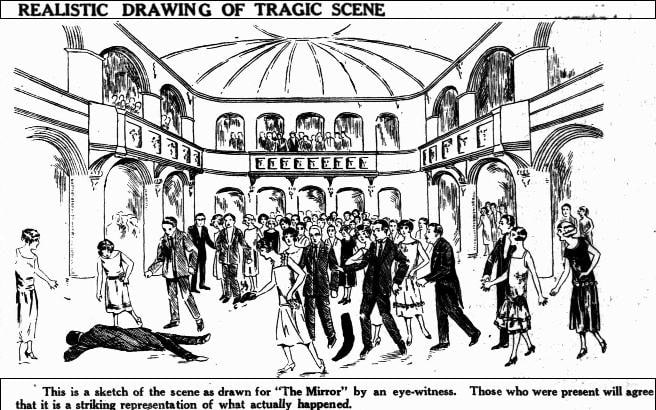
At a charity ball in the Government House Ballroom in Perth on the night of 26 August 1925, Audrey Jacob, a 20-year-old art student, shot her former fiance Cyril Gidley through the heart in front of hundreds of revellers.

Gidley, a 25-year-old ship's engineer, had ended their engagement months earlier, dramatically throwing the engagement ring into the sea. Audrey had attended the ball in costume as Pierrette, a lovesick clown; when Gidley ignored her all evening, she slipped away, changed into a striking blue evening gown, and returned. As the orchestra struck up an encore dance number, she approached him on the floor. A single shot rang out and Gidley collapsed without a word.

Audrey stood over the body, smoking gun in hand, and declared to the stunned crowd: 'I did it. Take me away. It's all right. I know what I've done.' She claimed the gun discharged accidentally during a confrontation. The case became a media sensation and led to a landmark trial in which she was found not guilty.

Murder On The Dance Floor

⬅ See all events from 27 August

Spread the word on your favourite platform!

1984: The Fine Cotton Ring-In That Shook Australian Racing

On 18 August 1984, a carefully orchestrated betting scam unfolded at Eagle Farm Racecourse in Brisbane. A syndicate headed by former bloodstock agent John Gillespie entered a horse under the name Fine Cotton, a poor performer racing at 33-1, then sent out Bold Personality, an open-class horse several grades above, crudely disguised with Clairol hair dye and white paint to mimic the brown gelding's markings. The plunge was unmistakable: Fine Cotton's odds crashed to 7-2 as money flooded in at tracks and TABs across the country.

Stewards grew suspicious at the dramatic form reversal and disqualified the horse. The botched disguise, paint flaking, colouring mismatched, made the fraud obvious. Trainer Hayden Haitana was disqualified and prominent Sydney bookmaker Robbie Waterhouse lost his licence for 17 years. The Fine Cotton scandal remains one of the most shambolic and notorious frauds in the history of Australian thoroughbred racing.

Horse racing
Horse racing

⬅ See all events from 18 August

Spread the word on your favourite platform!

1971: The Stanford Prison Experiment: When a Simulation Turned Brutal

In August 1971, Stanford University psychology professor Philip Zimbardo launched a two-week simulation of prison life using 24 male college students, randomly assigned as either guards or prisoners. Recruited through a newspaper advertisement, participants were paid $15 a day. Within days, the guards, given uniforms designed to strip individual identity, began psychologically abusing the prisoners with escalating cruelty.

The experiment collapsed on the sixth day after psychologist Christina Maslach visited the site and confronted Zimbardo over the conditions she witnessed. He shut it down, later admitting he had become too absorbed in his own role as superintendent. The study became a landmark case in research ethics, prompting American universities to strengthen institutional review processes for human experimentation. Later critics, including researcher Thibault Le Texier, argued the guards had been coached to behave aggressively, and that Zimbardo's conclusions were largely written before the experiment began.

Prisoner hands gripping steel lattice close up

⬅ See all events from 14 August

Spread the word on your favourite platform!

1917: Tilly Devine Marries an Australian Soldier in London, Sealing a Turbulent Union

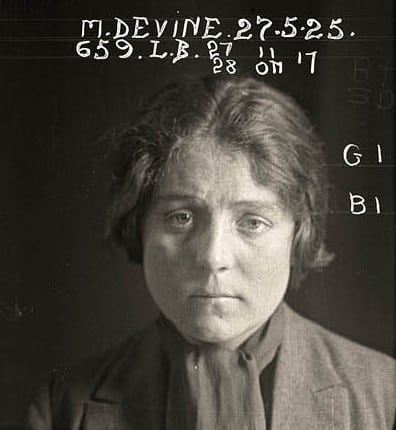
Matilda Twiss, born in Camberwell, London in 1900, married James Edward Devine, an Australian soldier serving in World War I, on 12 August 1917. Jim Devine, known as 'Big Jim', was a Victorian-born digger with a reputation for being sour and quick-tempered; Tilly was vivacious and already working as a prostitute. The pair were opposites in almost every way.

Tilly followed Jim to Sydney after the war, arriving in February 1920 and quickly building a criminal empire centred on Darlinghurst and Kings Cross. As the self-styled Queen of Woolloomooloo, she became one of the most notorious figures in the razor gang wars of the late 1920s and early 1930s. The marriage lasted 25 years before ending in divorce in 1943.

Portrait of Tilly Devine in 1925

⬅ See all events from 12 August

Spread the word on your favourite platform!
On This Day in True Crime History

Subscribe to Dark Stories

True crime stories, dark history and tour news, straight to your inbox.