Archives: Dark Stories: On This Day In True Crime History - Page 57
Supreme Court Justice Christopher Beale handed Erin Patterson three life sentences for murder and 25 years for attempted murder, setting a non-parole period of 33 years. That means Patterson, who poisoned relatives with a beef Wellington laced with death cap mushrooms, cannot be considered for release until 2056, when she would be 82 years old.
The judge described the crime as an ‘enormous betrayal’ marked by substantial premeditation, and noted that Patterson had shown no remorse for the deaths she caused.
Annie Chapman was a heavy drinker who had turned to prostitution in London’s Whitechapel after her marriage collapsed and her daughter died, using the earnings to pay for drink and a bed for the night. On the night of her death she had no money for lodgings and went out to earn her rent; her body was found in the early hours in a backyard, her throat cut and her abdomen slashed open.
The killer had arranged her intestines over her shoulder and removed her uterus, taking it with him. An autopsy determined she had been sober at the time of her death, ruling out the drunkenness that had shaped so much of her life.
Her murder, following that of Mary Ann Nichols just over a week earlier, confirmed for police that a single killer, soon dubbed Jack the Ripper, was stalking the women of Whitechapel.
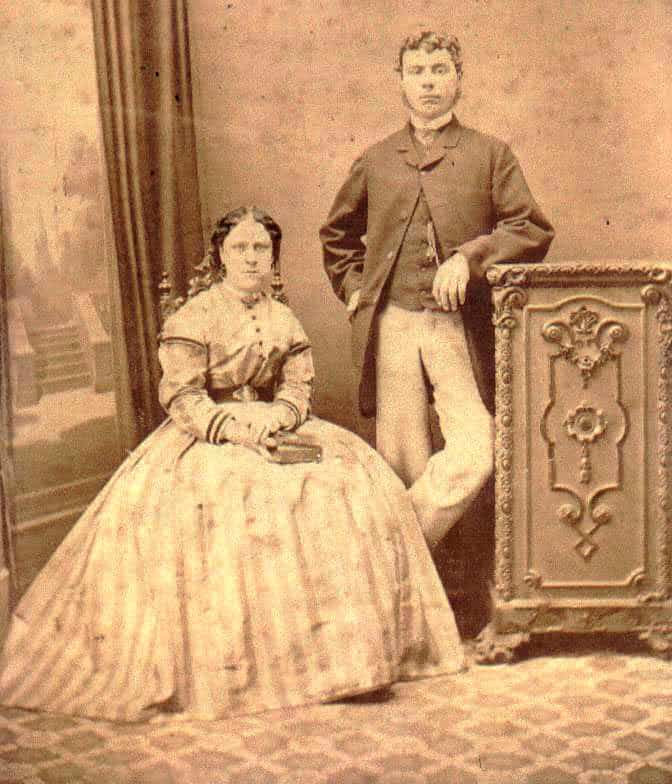
Portrait of Annie Chapman with her husband in 1869
Harold Shipman was arrested on 7 September 1998 after police investigated the death of his patient Kathleen Grundy, who had left him £386,000 in a will that turned out to be forged. The clumsy fake unravelled quickly: a Brother typewriter matching the one used to produce the document was found in Shipman’s possession, and Grundy’s own family, alarmed that their mother would never have cut them out, had already raised suspicions with a solicitor.
The arrest opened the door to a far larger inquiry. Detectives uncovered a pattern of lethal diamorphine injections administered to elderly patients under his care, alongside falsified medical records designed to make the deaths look natural.
Shipman was eventually linked to the deaths of at least 215 patients over more than two decades, making him one of the most prolific serial killers in British history.
Last will and testament typed on aged paper with vintage typewriter
Hunters searching brush near Interstate 90 in Issaquah, Washington, about one mile from Lake Sammamish State Park, stumbled on fragmented human remains scattered across the ground. Forensic examination identified them as Janice Ott and Denise Naslund, two young women who had vanished from the park on the same afternoon in July 1974 after a man with his arm in a sling, calling himself Ted, asked each separately for help loading a boat onto his car.
Among the bones was one extra femur that did not belong to either woman. It was later attributed to Georgeann Hawkins, a University of Washington student who had disappeared weeks earlier while walking a short alley between her boyfriend’s dormitory and her sorority house, her body never otherwise found.
The discovery helped investigators connect a string of disappearances across Washington and Utah to the same killer, Ted Bundy, whose calm, disarming manner and use of a fake injury to lure victims would become one of the most chilling signatures in American criminal history.
Sammamish Lake and Mount Rainier in background near Seattle