President Woodrow Wilson vetoed it, warning that banning alcohol while rationing wartime grain made no sense now the war was over. Congress disagreed, and on this day in 1919 the Senate and House of Representatives overrode his veto, pushing the Volstead Act into law and setting a date to enforce the newly ratified Eighteenth Amendment.

The Act gave Prohibition its teeth: it defined any drink over 0.5 percent alcohol as illegal and handed federal agents the power to raid, seize and prosecute. Within months, that vacuum would be filled not by sobriety but by bootleggers, speakeasies and the organised crime syndicates who built fortunes smuggling what the law had just made forbidden.
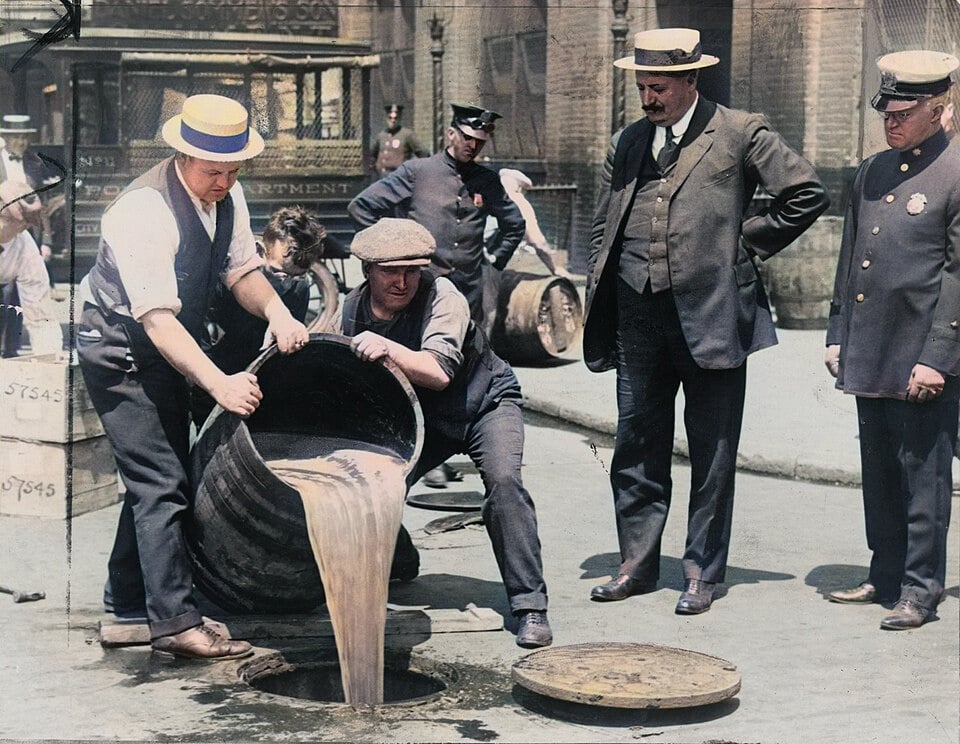

New York City Deputy Police Commissioner overseeing the disposal of confiscated liquor during Prohibition, c. 1921. Source: Library of Congress.

⬅ See all events from 28 October

Spread the word on your favourite platform!

Henry Sherry had formed an attachment to Catherine Waldock, the wife of a neighbouring farmer near the Williams, and proposed they elope together; when she refused, he borrowed a gun and strychnine from a neighbour under the pretence of shooting a hawk. On 16 September 1885 he intercepted her and her two young sons as they walked home from an opossum hunt, led her a short distance away, raised the gun and said “Here goes” before shooting her dead in front of the boys.

The horror deepened once he was found the next morning. Sherry told a neighbour it had all been agreed between them, a pact in which he would kill Catherine and then himself. He claimed to have already swallowed the strychnine and tried to drown himself in a nearby pool, but both attempts failed, “I floated on the top like a corpse.” Resigned to his fate, he said plainly, “I am not going to build up any false hopes; I expect the rope for it.”

Tried and convicted of murder, he was hanged in Perth on this day in 1885. Witnesses described him walking to the scaffold erect and composed, showing almost no sign of fear as the trapdoor fell.

In a letter written to his wife before his death, Sherry acknowledged the “great sin” he had committed and admitted the justice of his sentence.

Signing a one sided death pact

⬅ See all events from 27 October

Spread the word on your favourite platform!

William Page, a groom at Hedley Park near Mount Gambier, had courted a young woman named Mary Buchan for months, though she confessed to her family that she loved him but feared him. On the night of 11 July 1875 she left to walk with him after church and was never seen alive again.

Weeks of fruitless searching followed, until two people who had never met, Buchan’s own father and the wife of the investigating police inspector, each separately dreamed that the dead girl led them to a ploughed field marked by three trees. Acting on the strange coincidence, police searched the spot and found her body buried about eighteen inches down, her hands bound with her own handkerchief.

Page was arrested, tried, and hanged at Mount Gambier on this day in 1875.

In a signed confession he admitted striking Buchan with a stockwhip handle after she tried to end their relationship, then strangling her when he believed the blow had been fatal. He insisted the killing was done only ‘in a fit of passion’ and expressed deep remorse before his death.

A Dream led them to the same location.

⬅ See all events from 27 October

Spread the word on your favourite platform!

Abraham Munday, a shepherd working the east coast of Tasmania near Swansea, laced a rival shepherd’s flour with arsenic, hoping to kill George White. White survived only because the dose was so large it made him vomit it back up. An old man named Hamilton, who happened to share a piece of the poisoned bread while visiting the hut, was not so fortunate: the arsenic settled in his joints and left him crippled for life.

Munday was convicted and sentenced to death. He was hanged within the gaol at Oatlands on this day in 1857, and went to the scaffold badly shaken, not only by his fate but because the clergyman who had attended him in his final days, the Reverend Mr Ison, refused to walk up to the drop with him.

Antique apothecary poison bottle

⬅ See all events from 27 October

Spread the word on your favourite platform!
On This Day in True Crime History

Subscribe to Dark Stories

True crime stories, dark history and tour news, straight to your inbox.