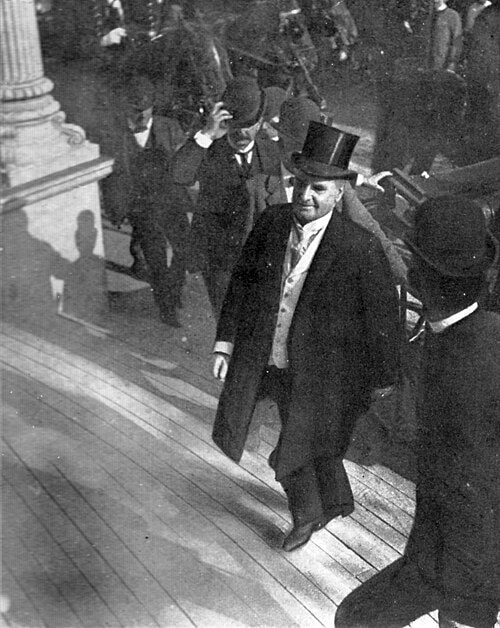
Theodore Roosevelt was sworn in as the 26th President of the United States on September 14, 1901, hours after President William McKinley died from gunshot wounds inflicted eight days earlier by anarchist Leon Czolgosz at the Pan-American Exposition in Buffalo, New York.
McKinley had been shaking hands with the public when Czolgosz approached with a concealed revolver wrapped in a handkerchief and fired twice at close range. Roosevelt, then just 42, became the youngest man to assume the presidency, taking the oath in a private Buffalo residence rather than the traditional halls of power in Washington.
Bulgarian dissident Georgi Markov was waiting for a bus on Waterloo Bridge in London when he felt a sudden sharp pain in his leg. He turned to see a man pick up a dropped umbrella and hurry away, offering a mumbled apology. Markov thought little of it until a small red mark and fever set in over the following days.
The umbrella had been rigged to fire a tiny pellet packed with ricin, a poison for which there was and is no antidote. Markov died four days later, on 11 September 1978, from the resulting blood poisoning, becoming one of the most infamous casualties of Cold War espionage.
His killer would not be identified for almost three decades. It was not until 2005 that leaked files named the assassin as Francesco Gullino, an agent working for the Bulgarian secret service, though he was never extradited or tried for the murder.
Salvatore Maranzano, nicknamed Little Caesar for his fascination with Julius Caesar and the Roman Empire, had built a criminal empire in Brooklyn behind the front of a real estate brokerage, running bootlegging, prostitution and narcotics rackets. Born in Castellammare del Golfo, Sicily, and married to Elisabetta Minore, he was sent to New York to seize control of Mafia operations for his Sicilian backers.
In 1930, he went to war with rival boss Joe Masseria, sparking the Castellammarese War. Maranzano secretly convinced Masseria’s own lieutenant, Lucky Luciano, to betray him, and after a lunch at a Coney Island restaurant on April 15, 1931, Masseria was gunned down.
Maranzano emerged as capo di tutti capi, the boss of all bosses, and reorganised New York’s underworld into the Five Families. His triumph lasted only five months. After plotting to have Luciano killed, Maranzano discovered too late that Luciano had moved first. On September 10, 1931, four gunmen posing as government agents entered Maranzano’s Manhattan office and shot and stabbed him to death, dying in a manner fittingly similar to the fate of his idol, Julius Caesar.
Angry mobsters firing a submachine gun near an antique car
On September 6, 1901, President William McKinley was shot twice in the abdomen while shaking hands with the public at the Temple of Music during the Pan-American Exposition in Buffalo, New York. His attacker, 28-year-old Leon Czolgosz, was an anarchist who had lost his job in the Panic of 1893 and come to regard McKinley as a symbol of oppression. Despite appearing to recover initially, McKinley died on September 14 from gangrene caused by his wounds, becoming the third American president assassinated after Abraham Lincoln and James A. Garfield.
Czolgosz was convicted of first-degree murder within a month and executed by electric chair on October 29, 1901. McKinley was succeeded by Vice President Theodore Roosevelt. In the aftermath, Congress formally charged the Secret Service with protecting the president.