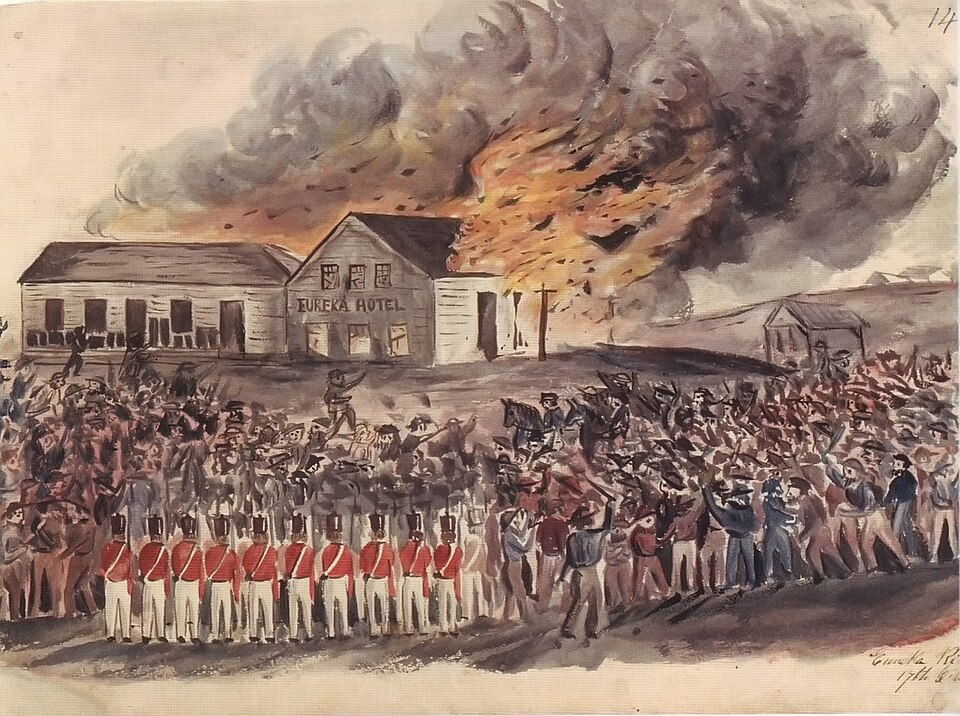
When the men accused of killing miner James Scobie walked free, the goldfields of Ballarat erupted. Roughly ten thousand miners massed near the Eureka Hotel, the pub where Scobie had been beaten to death, convinced the verdict was a stitch-up between the publican and the authorities.
The crowd set the hotel ablaze and turned on the officials sent to calm them: Gold Commissioner Rede was pelted with eggs as police and soldiers failed to restore order. The riot was a direct spark for the unrest that would culminate weeks later in the Eureka Stockade, one of the defining clashes of Australian colonial history.
Burning of Bentleys Hotel during the Eureka Riot 1854
James Scobie, a Scottish gold miner, was killed outside Bentley’s Hotel at Ballarat on this date after he and a companion found the pub shut and tried to get in. A hand smashed through a window to strike him, the publican’s wife accused him of breaking it, and as he fled a group of men caught up with him; one blow, delivered with something Peter Martin, the only witness, described as resembling a battle-axe, killed him on the spot.
At the inquest that same afternoon, hotelkeeper James Bentley and his staff denied any involvement, and despite a strong case against them the magistrate let the matter drop. Miners furious at the whitewash burned Bentley’s Hotel to the ground, and only after public outcry was a fresh trial held at Melbourne‘s Supreme Court, where Bentley and two others were convicted of manslaughter. The anger over Scobie’s death and its botched cover-up became one of the sparks that lit the Eureka Rebellion weeks later.
Annie Thornton, was murdered in her home at Carlton, a suburb of Melbourne, on the night of 10 July 1889. Piercing screams were heard coming from the house that night, but no neighbour intervened and nothing was reported to police until the inquest weeks later.
The man committed for trial, Filipe Castillo, showed almost total indifference to his fate. On the very night of the killing he was seen with another woman and showed her a bloodstained waistcoat, claiming it came from a cut to his arm. He then handed out jewellery stolen from the dead woman to several other women, including the wedding ring he had taken from her finger.
The murdered woman’s husband, Henry Thornton, had been living apart from his wife and was working in Ballarat at the time. On hearing of the killing he walked into the Ballarat watch-house himself, gave a detailed account of his movements and produced letters proving he had not seen his wife since parting from her on good terms months earlier; he was cleared of any involvement.
At the inquest a verdict of wilful murder was returned, and the accused was described as remarkably unconcerned throughout the proceedings. He was tried, convicted and hanged at Melbourne Gaol on 16 September 1889 for one of the most brutal and cold-blooded murders Melbourne had seen.
In December 1884, plain-clothes Detective Sergeant Hyland was pursuing a suspect wanted as an accomplice in a wool-stealing robbery at Kyneton. Acting on a tip that the man had been seen asking questions near the Gong Gong hotel, Hyland and Senior Constable Hehir hired a cab and tracked him along the road near Brown Hill. When Hyland stepped out and approached, the man drew a revolver and shot him in the shoulder at close range. Hyland rushed him before he could fire again, and a fierce struggle followed, with two more shots discharged into the ground and air before the man was handcuffed and taken into Ballarat. Surgeons at the hospital extracted the bullet from the sergeant’s back.
The man, Charles Bushby, also known as Baker, was convicted of attempted murder at the Ballarat Court and sentenced to death. He was hanged at Ballarat on 3 September 1885.
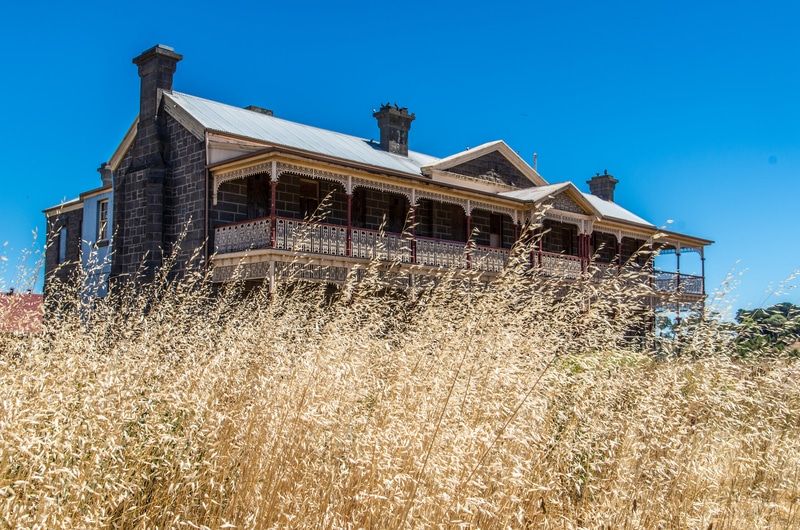
Old abandoned Kyneton Hospital building in Victoria, Australia