1862: A Slipped Mask Gives Away a Bushranger

On 14 September 1862, two bushrangers robbed a mailman near Mudgee in New South Wales. They let him keep his sixpence and his pipe. His horse and the mail went with them.

But one robber gave himself away when his crepe mask slipped. The mailman caught a glimpse of his face and believed he could identify him as the infamous bushranger Fred Lowry.

The mail run offered little chance of real profit. Some suspected the hold-up was a decoy to draw police away from a bigger job. News of an armed horse robbery nearby fed the theory, though the report established no connection.

Less than a year later, Lowry died after being shot by police. He reportedly asked that his brother-in-law be told “Tell ’em I died game”.
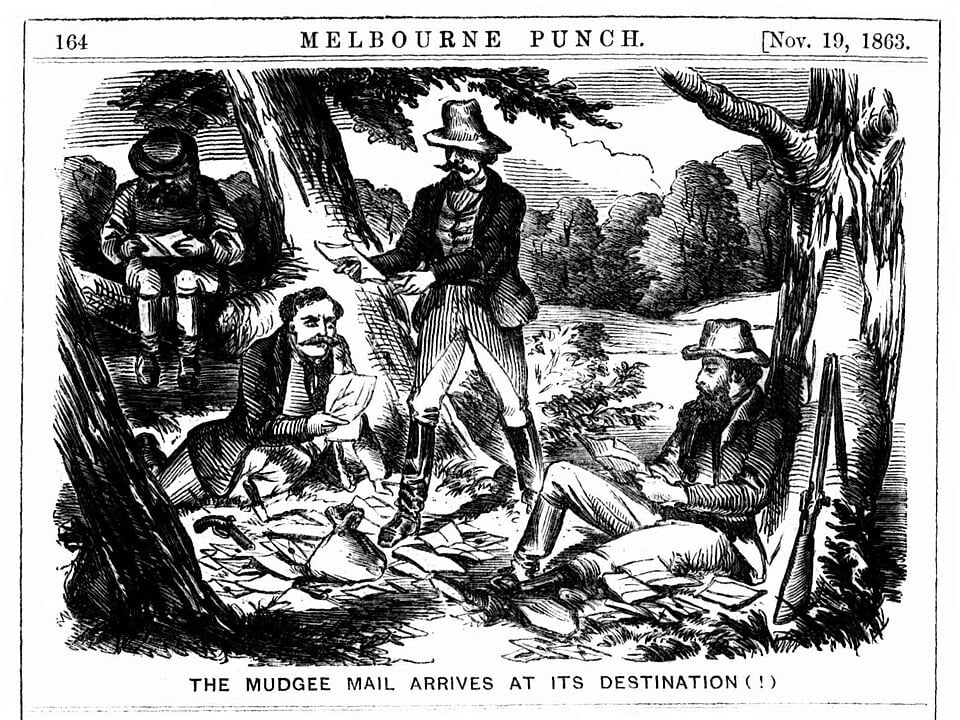

Mudgee Mail Delivery

⬅ See all events from 14 September

Spread the word on your favourite platform!
True Crime Scene Tape

1826: Escaped Convicts Turned Highway Robbers: Two Hanged After Fleeing Macquarie Harbour

John Taylor and George Waters had absconded from the notorious penal settlement at Macquarie Harbour, Van Diemen’s Land’s infamous secondary punishment station for repeat offenders, before turning to highway robbery. Their crime involved robbing soldiers of their arms, a particularly bold offence that ultimately led to their conviction.

Both men were sentenced to death on 2 September 1826 and hanged together at Hobart just eleven days later, on 13 September 1826.

British Army drum and muskets historical military equipment

⬅ See all events from 13 September

Spread the word on your favourite platform!
True Crime Scene Tape

1826: A Colonial Newspaper Pleaded for Mercy: Two Men Hanged at Hobart for the Murder of a Stock-Keeper

Thomas Colley, a stock-keeper at Oyster Bay in Van Diemen’s Land, was speared to death in 1826. Contemporary reports said the elder of the two Aboriginal men accused had concealed himself behind a fence, waited for his opportunity, then speared Colley. Both men were also charged in connection with the wounding of Colley’s employer.

Before trial, the elder man was reported to be suffering from leprosy and was kept apart from the other prisoners. During the hearing, he reportedly attempted to show that he did not understand English, although evidence was given that he spoke the language with reasonable ease.

Both men were convicted. At sentencing, one denied killing Colley and said the other man had thrown the spear, while his co-accused made no statement. Sentence of death was passed on 2 September 1826, and both men were hanged at Hobart on 13 September.

A contemporary newspaper questioned whether Aboriginal Tasmanians, with little or no knowledge of British law or Britain’s claim to their land, should be subjected to a legal system imposed by colonists. It also argued that the executions would have little deterrent effect, since other Aboriginal people were unlikely to witness them or even hear of them, and appealed for the condemned men’s lives to be spared.

Antique silver pocket watch resting on a vintage newspaper

⬅ See all events from 13 September

Spread the word on your favourite platform!
True Crime Scene Tape

1826: The Head Was Never Found: Three Men Hanged at Hobart for Murder

Alexander Simpson, a shopkeeper who lived and slept in two houses near Pittwater not far from Hobart, was last seen walking home at dusk. The next morning his body was found mutilated on rocks below the high-water mark, his head and much of his flesh removed and never recovered. A discoloured mark around his neck suggested he had been strangled with a cord before his body was carried to the water and cut apart, apparently to prevent identification. His shop had been completely rifled, yet the doors were found padlocked exactly as usual, suggesting the killers had taken his keys and relocked the premises after the robbery. Strangely, no footprints, blood or signs of a struggle were ever found.

Three neighbours who knew Simpson well, Thomas Dunnings, Edward Everitt and William Smith, stood trial for three days on largely circumstantial evidence, including stolen goods traced back to Simpson’s shop and their movements on the night of the killing. All three were convicted, sentenced to death on 2 September 1826 and hanged together at Hobart on 13 September 1826.

Each man gave a different account at the end. Dunnings insisted he had “had no hand in it”; Everitt admitted stealing goods from the house after Simpson’s death but denied any part in the murder; Smith maintained the evidence used to convict him was “entirely false.”

Vintage door secured with padlock and chain, lockdown security

⬅ See all events from 13 September

Spread the word on your favourite platform!
True Crime Scene Tape
On This Day in True Crime History

Subscribe to Dark Stories

True crime stories, dark history and tour news, straight to your inbox.