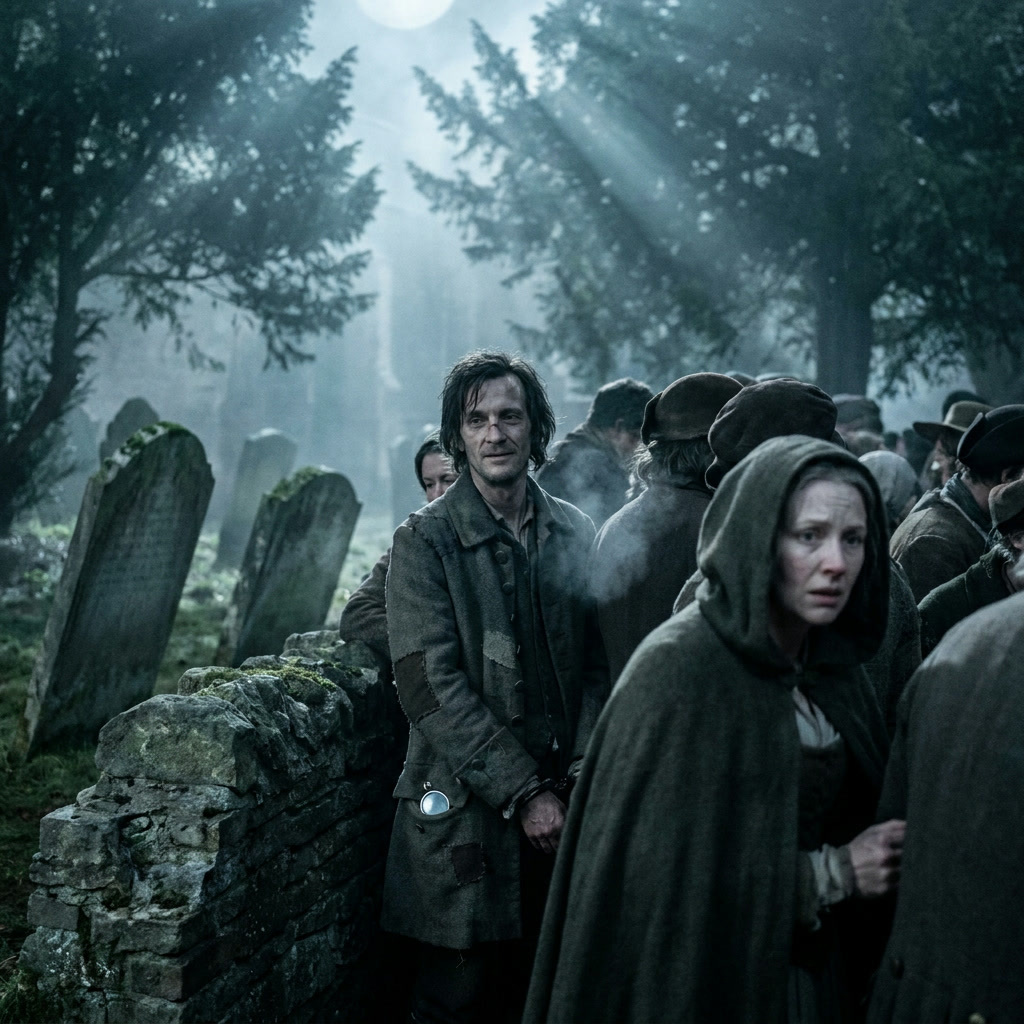
Richard James is barely twelve years old when the world discards him. His father, a nobleman's cook, vanishes from his life early, and the boy is packed off to sea: a disposable child in old England's long machine of poverty and neglect.
What follows is a restless orbit of misfortune: captured by Spaniards, taken in by a kind house-painter abroad, drawn home by longing for England, only to find that England has nothing left for him. He marries too young, loses his wife to another man, and drifts toward the only trade that pays without asking questions.
His story is one of the rawest pieces of true crime from old England's highways: listen now and ride the Oxford Road with Richard James.
He looked upon it as a very happy relief from a very troublesome and uneasy life.
CASE FILE No. 13
NAME
Richard James
AGE
about 30
WHEN
Early 1730s
WHERE
Oxford Road, Hanwell Green, London
CHARGE
Highway robbery
FATE
Hanged at Tyburn
SOURCE
Lives of the Most Remarkable Criminals, 1735
HANGED
Dark Lexicon: Old words. Dark meaning.
The past speaks its own dialect; here is what to listen for in this episode.
Profligate: in old England this did not simply mean wasteful with money; it described a person morally abandoned, someone who had thrown off all restraint. To call a man profligate was to say his soul was ruined as thoroughly as his purse.
Disobliged: today we might say 'offended' or 'alienated.' In old England, to disoblige someone was to undo whatever goodwill they owed you: a quiet, devastating word for burning your last bridges.
Betake him: an old reflexive phrase meaning to commit oneself to a course of action. When James 'betook him to the sea,' it meant he had no other path; it carried the weight of surrender.
Viz.: short for the Latin 'videlicet,' meaning 'namely' or 'that is to say.' Writers in old England dropped it into sentences the way we might write 'i.e.' today: a crisp, clipped signal that the ugly truth was about to be named.
Waggoners: not casual travellers but the commercial drivers hauling goods by wagon along England's main roads. Robbing waggoners on the Oxford Road was both profitable and ruthless: these were working men carrying other people's freight.
Reprieve: a temporary suspension of a death sentence. In old England a reprieve was not a pardon; it was a pause, a breath between the verdict and the rope, sometimes granted by royal mercy and sometimes simply delayed until the next hanging day.
Place of execution: almost always Tyburn, the notorious gallows west of London where crowds gathered to watch the condemned die. In old England, your last words at the scaffold were a public performance; the crowd expected a speech, and they judged you by how well you gave it.
Ignominious: shameful, publicly disgraceful. James used the word himself at the scaffold, naming his own death as a thing of dishonour: not because he feared it, but because he understood the spectacle the law was making of him.
About This Series
Lives of the Most Remarkable Criminals (1735) is one of the earliest works of true crime in the English language. Each week this podcast retells one of its stories for today's listener, keeping the old book's most striking lines.
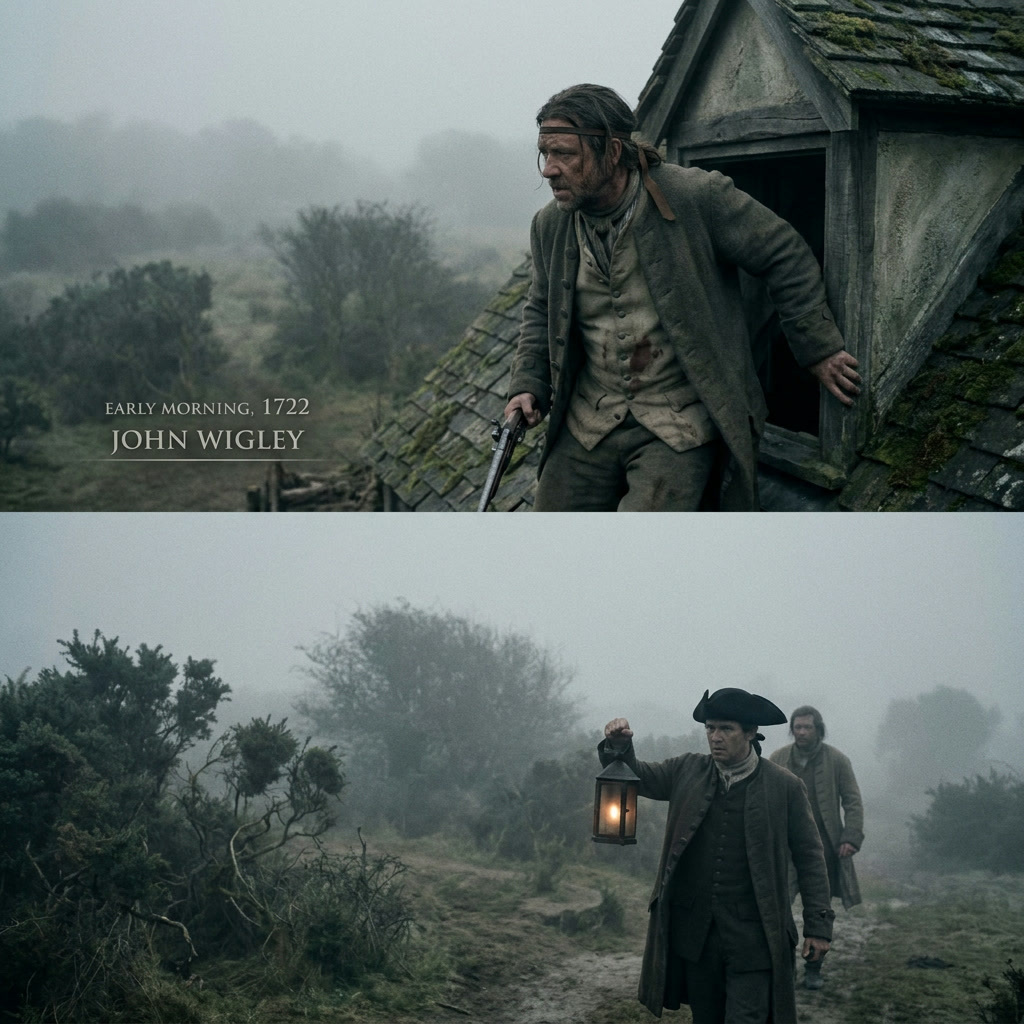
John Wigley is a plasterer by trade but a highwayman by nature, prowling the lonely roads around Finchley Common for years before a single night of company brings him down. He lives with an old woman who sells brandy on the common: the same woman whose former husband turned up dead in a barn near Hornsey under circumstances no one can quite explain.
In old England, the solitary robber was a rare breed; most thieves ran in gangs, bound by oaths and mutual threat. Wigley despises gangs, convinced that when a man's life is on the line, loyalty crumbles: yet the one time he breaks his own rule and rides out with two accomplices, everything falls apart.
Step onto the dark roads of old England and hear what happens when a lone wolf makes one fatal compromise.
When life came to be touched, they hardly ever failed of betraying all they knew.
CASE FILE No. 10
NAME
John Wigley
AGE
about 40
WHEN
1730s
WHERE
Finchley Common, Islington, London
CHARGE
Highway robbery
FATE
Hanged, same day as the malefactors last mentioned
SOURCE
Lives of the Most Remarkable Criminals, 1735
HANGED
Dark Lexicon: Old words. Dark meaning.
The past speaks its own dialect; here is what to listen for in this episode.
Ill courses: a polite way of saying a criminal lifestyle. In old England, to fall into 'ill courses' meant sliding from honest work into theft, fraud or worse: a moral descent wrapped in gentle phrasing.
Confederacies in villainy: organized criminal partnerships, what we would simply call gangs today. In old England, the word 'confederacy' carried a whiff of treasonous conspiracy, making even a band of petty thieves sound like plotters against the state.
Malefactor: a person who commits a crime, from the Latin for 'one who does evil.' Courts and chroniclers in old England favoured this term; it carried a moral weight that 'criminal' somehow lacks.
Benighted: today it means ignorant or unenlightened, but in old England it meant literally overtaken by nightfall while travelling. Being benighted on a country road was genuinely dangerous: you might stumble into a ditch, a barn, or the path of someone like Wigley.
Rapine and plunder: rapine is the violent seizure of property, a step beyond mere theft. Paired with plunder, it describes a life of aggressive, predatory crime: taking by force whatever you could carry.
Sessions: the regular sittings of a criminal court, typically held at the Old Bailey in London. In old England, the 'ensuing sessions' meant the next scheduled court date: your window between arrest and trial could be agonizingly short.
Immediate hand of Providence: the belief that God actively intervened to prevent criminals from prospering. Wigley himself observed this pattern: no matter how much a thief stole, the money seemed to evaporate, as though a divine force ensured crime never paid.
About This Series
Lives of the Most Remarkable Criminals (1735) is one of the earliest works of true crime in the English language. Each week this podcast retells one of its stories for today's listener, keeping the old book's most striking lines.
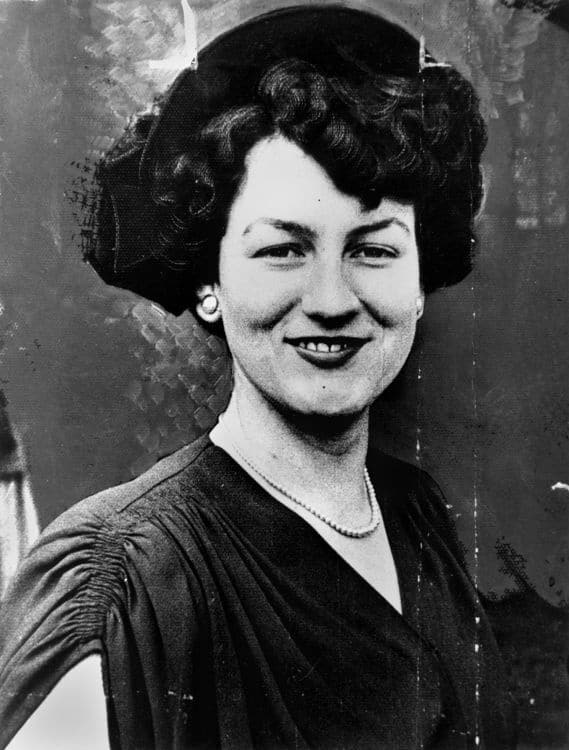
The unsolved murder of Betty Shanks in 1952 remains one of the most disturbing and enduring cold cases in Australian criminal history. On a quiet September evening in suburban Brisbane, a young woman was violently beaten to death just a few hundred metres from the safety of her parents' home, and no one has ever been held accountable. Her killing sent shockwaves through a city still settling into peacetime life, and even decades later, it continues to haunt investigators, amateur sleuths, and the people of Brisbane who remember a time when the suburbs felt untouchable by violence. This is the story of Betty Shanks, the investigation that could not solve her murder, and the silence that followed.
Post-War Brisbane and the Quiet Streets of the Inner North
By 1952, Brisbane was a city in transition. The war years had transformed it from a provincial capital into a strategic military hub; American GIs had flooded Fortitude Valley and the CBD, and the social fabric of the city had been stretched and reshaped in ways that lingered long after the troops went home. Peace had returned, but normalcy was still being negotiated. Housing was tight. Families were rebuilding. The suburbs, particularly the leafy inner-north pockets like Wilston and Grange, represented the aspirational heart of that recovery: quiet, respectable, safe.
Betty Shanks was 22 years old, a bright and well-liked young woman who worked as a clerk for a Commonwealth Department. She lived with her parents at their home in Grange. By all accounts, she was modest, dependable, and deeply embedded in the rhythms of ordinary suburban life. She caught the tram to work. She came home in the evenings. There was nothing in her routine that should have placed her in danger. And yet, on the night of 19 September 1952, the short walk from the tram terminus at Grange to her parents' house became the last journey she would ever take.
The Night of 19 September 1952
Betty had been out that evening, attending a night lecture in the Brisbane CBD. After the lecture, she was driven part of the way home by her lecturer, then boarded a tram at Windsor and alighted at the Grange terminus, as she had done countless times before. From there, it was a walk of only a few hundred metres through quiet residential streets to her family home. The route was familiar. The streets were lit, if dimly. The homes she passed were occupied by families she likely recognised. It was an unremarkable journey on an unremarkable night.
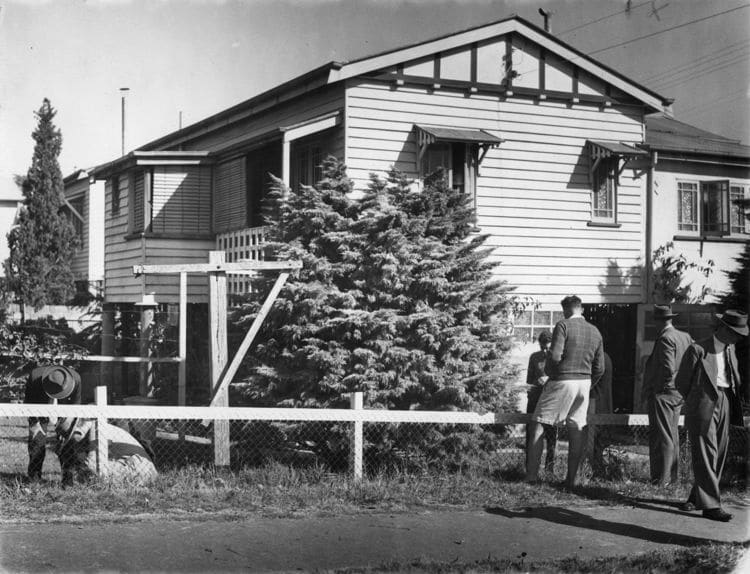
She never made it home. Betty's body was discovered the following morning in the front garden of a house at the corner of Thomas and Carberry Streets, Grange, just a short distance from her own front door. She had been savagely beaten and kicked, with police finding no evidence of robbery. Her belongings were intact. The motive, like the killer, remained invisible.
The Investigation: Every Lead Gone Cold
Queensland Police launched what was, by the standards of 1952, a significant investigation. Officers canvassed the neighbourhood extensively, interviewing residents of both Grange and Wilston, tram conductors, passengers, and anyone known to have been in the area that evening. The crime scene was examined, though forensic science of the era was limited; there was no DNA analysis, no CCTV, and fingerprint technology was rudimentary at best. Detectives relied on witness testimony, but it was devastatingly scarce.
Several persons of interest were identified in the weeks and months that followed. Among them were men known to Betty through social or professional circles, as well as local figures flagged by neighbours. One name that recurred in community whispers was never substantiated with evidence. Another suspect, a man reportedly seen near the tram terminus that night, could not be conclusively placed at the scene. Each line of inquiry was pursued, and each, in turn, dissolved into ambiguity. No one was ever charged.
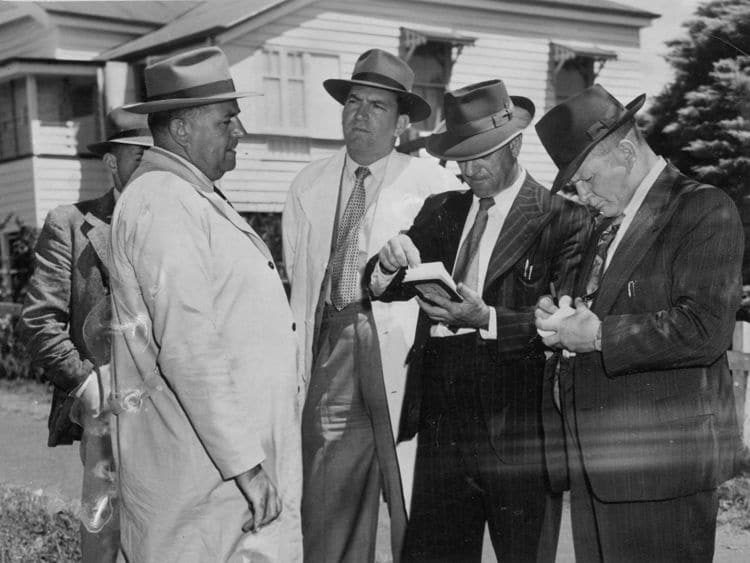
One detail that adds a striking layer of institutional context to this case is the presence of Inspector Frank Bischof at the crime scene. Bischof, photographed during the early investigation, would later become Queensland Police Commissioner and a controversial figure in the history of Queensland policing before the Fitzgerald Inquiry. In the Betty Shanks case, however, his presence is best understood as a historical side note rather than evidence of any particular failing in the investigation.
#image_title#image_title#image_title
The Tram Terminus Question
One of the most confounding aspects of Betty Shanks' murder is its proximity to public space. The Grange tram terminus was not an isolated location. Trams ran regularly. Passengers boarded and alighted throughout the evening. Conductors were present. The surrounding streets, while quiet, were residential and populated. How could a young woman be attacked and killed just metres from a public transport stop, on a route flanked by occupied homes, without a single reliable witness coming forward?
The answer likely lies in the nature of 1950s suburban life after dark. Streets were poorly lit by modern standards. Most residents were indoors by the time Betty alighted from the tram. The attack may have been swift; a sudden ambush from a laneway or garden hedge, carried out by someone who knew her route or who had followed her from the terminus. Sound carries unpredictably in suburban streets, and what might have been heard could easily have been dismissed as a domestic disturbance or an animal. In an era before triple-zero calls and neighbourhood watch programs, the gap between a cry for help and a response could be fatally wide.
The tram angle has been revisited many times. Investigators looked at whether the killer might have been a fellow passenger, someone who rode the same route and followed Betty on foot. They examined whether a tram employee might have known her routine. None of these avenues produced a breakthrough. The tram, which should have been a cocoon of safety delivering Betty to the edge of her own neighbourhood, instead marked the boundary between her life and her death.
Reinvestigations and Cold Case Reviews
Betty Shanks' case has never been officially closed, and it has been revisited several times by Queensland Police and independent researchers. Cold case reviews in the 1990s and 2000s brought modern forensic techniques to bear on the surviving evidence, though decades of neglect had degraded much of it. DNA technology, which has revolutionised cold case work in Australia and globally, offered limited assistance here; the original crime scene processing did not preserve biological material in ways compatible with later analysis.
Journalists and true crime researchers have combed through witness statements, coronial records, and police files released under freedom-of-information provisions. Each reinvestigation has added texture to the story: new theories about suspects, new readings of the available evidence, and new frustrations at the gaps in the original investigation. Some researchers have pointed to the limitations of 1950s policing culture, in which certain lines of inquiry may have been abandoned prematurely or in which the era's social dynamics discouraged witnesses from speaking freely.
Despite these efforts, no reinvestigation has produced sufficient evidence to name a suspect, let alone secure a prosecution. The case remains listed among Queensland's most significant unsolved homicides, a designation that carries both institutional weight and a quiet admission of failure.
Betty's Family: A Grief Without Resolution
It is easy, after so many years, for a victim to become an abstraction; a name in a case file, a photograph in a newspaper archive, a footnote in the history of Brisbane crime. But Betty Shanks was a real person, with a family who loved her and who lived the rest of their lives in the shadow of her murder. Betty's parents lost their daughter in the most violent and inexplicable way imaginable, and they never received the closure of knowing who was responsible or why.
Betty's younger brother carried that burden forward. The Shanks family home, the very place Betty was walking toward when she was killed, became a monument to absence. Every anniversary, every newspaper retrospective, every cold case review reopened the wound without healing it. For families of unsolved murder victims, grief does not follow a linear path; it circles endlessly, caught in the orbit of unanswered questions. Who did this? Why? Were they ever caught for something else? Did they live out their life unpunished, walking the same streets Betty once walked?
The human cost of an unsolved murder extends far beyond the victim. It radiates outward through family, through community, through the collective memory of a city. Betty Shanks deserved justice. Her family deserved answers. Neither has been delivered.
Decades of Silence
As of now, no one has ever been charged with the murder of Betty Shanks. Although various theories and alleged suspects have emerged over the decades, no officially accepted suspect has been identified, no deathbed confession has resolved the case, and no DNA match has materialised. The person who killed Betty on that September night in 1952, only a few hundred metres from her family's doorstep, either died with their secret or is still alive and extraordinarily old, carrying a truth that no investigator has been able to extract. Decades of silence. That silence is not peace; it is its own kind of horror. It is the sound of a case that was never closed, a family that was never given answers, and a city that has never quite forgotten the night a young woman stepped off a tram at Grange and vanished into violence.
This article is part of the Dark Stories series profiling Australia's most infamous criminals, unsolved cases, and the darkest chapters of the nation's history, presented in no particular order. From suburban murders to organised crime empires, from colonial atrocities to modern-day mysteries, we are building an archive of the cases that shaped Australia's relationship with crime and justice. One day, we will rank them: the most shocking, the most consequential, the most haunting. Until then, we keep telling the stories that deserve to be remembered, because forgetting is its own form of injustice.
Spread the word on your favourite platform!
Subscribe to Dark Stories
True crime stories, dark history and tour news, straight to your inbox.