Edgar Allan Poe vanished for nearly a week before he turned up outside a Baltimore, Maryland tavern being used as a polling place, incoherent and wearing clothes that were not his own. He was taken to Washington College Hospital, where he drifted in and out of consciousness for four days.
Witnesses said he repeatedly called out the name Reynolds in his final hours, a man no one has ever identified. Poe died on 3 October 1849 at age 40, and no doctor ever agreed on what killed him, leaving one of American literature’s most famous authors with one of its strangest unsolved endings.
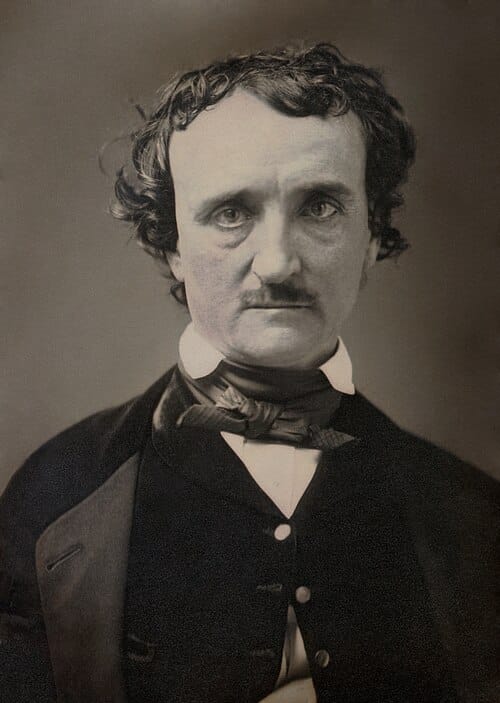
Restored portrait photo of Edgar Allan Poe circa 1849
In September 1656 the General Provincial Court at Patuxent, Maryland impanelled the first all-woman jury in the American colonies to try Judith Catchpole, an indentured maidservant accused of murdering her newborn child. The accusation came from a fellow passenger on the voyage from England, who also claimed she had cut a sleeping woman’s throat and stabbed a seaman in the back, then, in the same breath, that she had stitched the throat wound closed before the victim woke and rubbed grease on the seaman’s wound to bring him back to life.
The jury of seven married and four single women was chosen specifically because the case turned on medical evidence only women could assess: whether Catchpole’s body showed any sign of having recently given birth. Their physical examination found no such evidence, and witnesses testified that her accuser, who had died before the trial, was not of sound mind.
Catchpole’s defence rested on a simple claim: she had never been pregnant at all. With no proof of childbirth and the accuser’s own tales dismissed as delusional talk of witchcraft, the jury acquitted her of every charge.