In August 1963, Perth police discovered a rifle hidden in bushes, linked to the murder of Shirley McLeod. Rather than remove it, they set a trap: replacing the weapon with an inoperable replica tied with fishing line, then waited.
On 1 September 1963, Eric Edgar Cooke returned to retrieve the rifle and was arrested on the spot. Under questioning, he confessed to 22 violent crimes, including eight murders, making him one of the deadliest serial killers in Australian history.
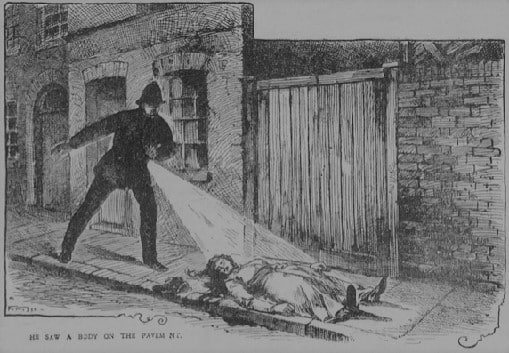
Mary Ann Nichols, known as Polly, was 43 years old, a divorced mother of five, and homeless on the night she died. In the early hours of 31 August 1888, she went to the streets of Whitechapel, London, to earn money for a bed. Her body was found before 4 a.m., her throat slashed with a long-bladed knife and her abdomen deeply cut. There were no witnesses.
Nichols became the first of at least five women murdered in and around Whitechapel between late August and early November 1888 by the killer who would become known as Jack the Ripper. Her death ignited intense press and public interest in both the murders and the desperate living conditions of London’s East End.
Despite countless theories, the killer Jack The Ripper, has never been identified.
Illustration of PC Neil discovering the body of Mary Ann Nichols with his lantern. Unknown artist, 1888. Published in Famous Crimes Past and Present, c.1903. Public domain.
For months in 1985, Richard Ramirez, the Night Stalker, terrorised California, breaking into homes while families slept to assault, mutilate, and murder. His reign of terror ended not with a police operation but with a newspaper front page: once his mugshot was published across California media, his anonymity was gone.
On 31 August 1985, Ramirez attempted to carjack vehicles in the Boyle Heights neighbourhood of East Los Angeles. Residents recognised him, chased him down the sreet, and beat him to the ground before police arrived to take him into custody. Facing the mob, Ramirez reportedly confessed to officers, preferring arrest to the alternative.
Edward Theodore Gein was born on August 27, 1906, in Plainfield, Wisconsin. He would become one of the most disturbing figures in American criminal history, a murderer and body snatcher whose crimes shocked the nation when they were uncovered in November 1957. Authorities searching his farm found the decapitated, mutilated body of hardware store owner Bernice Worden hanging upside down in a shed, dressed out like a deer. Gein had also been raiding local graveyards for years, fashioning keepsakes from the bones and skin of exhumed corpses.
Gein confessed to two murders: Worden in 1957 and tavern owner Mary Hogan in 1954. Found legally insane, he was committed to a psychiatric institution and never stood trial. He died in 1984. His crimes inspired some of fiction’s most iconic killers in movie history.