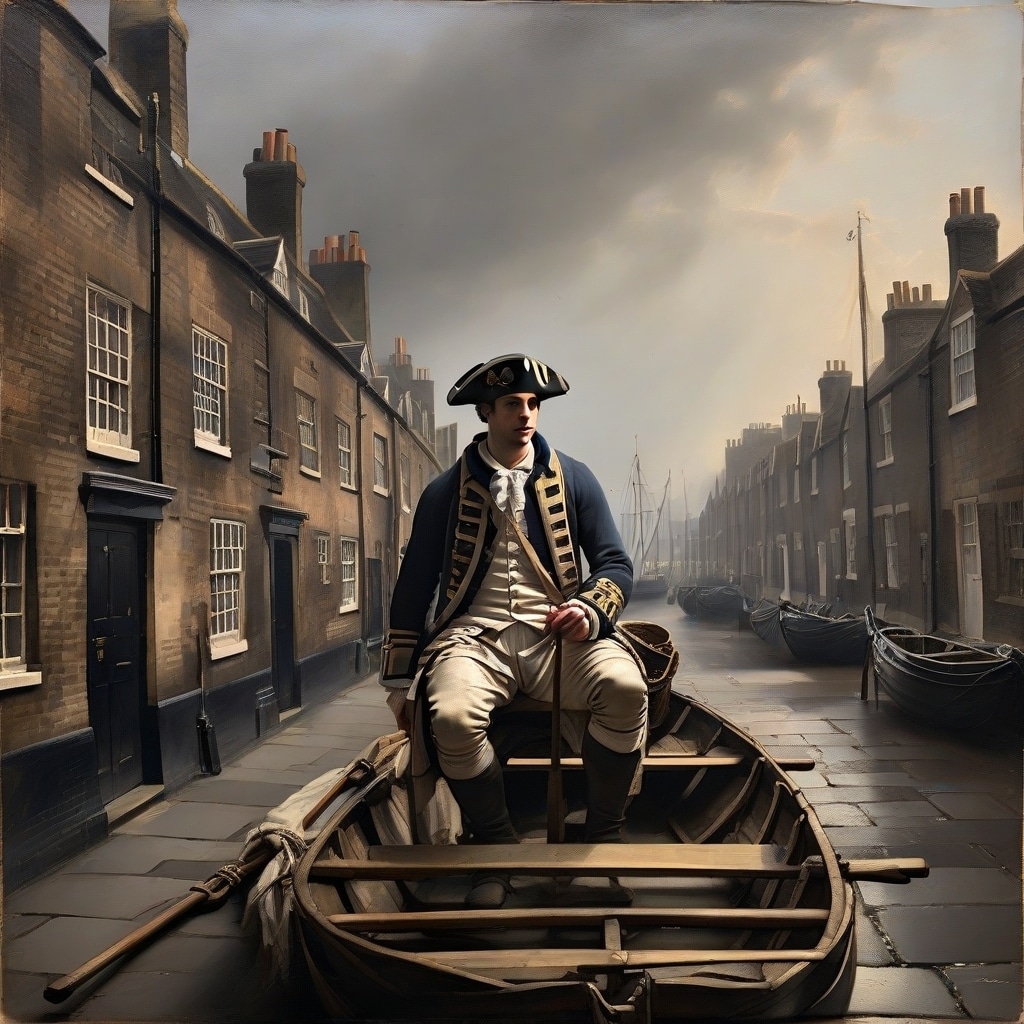
Walter Kennedy grows up at Pelican Stairs in Wapping, the son of an anchor-smith, a boy with every reason to follow his father into honest labour. But something restless burns in him; as Lives of the Most Remarkable Criminals tells it, he possesses a ‘too aspiring temper’ that honest trades can never satisfy.
Serving aboard a man-of-war during Queen Anne’s wars against France, Kennedy absorbs every whispered tale of buccaneers and maritime desperadoes, and what begins as fascination hardens into ambition. His is a true crime story shaped not by sudden desperation but by slow, deliberate seduction; the sea offering its own dark curriculum.
The silver oar of Admiralty justice waits somewhere ahead of him, gleaming on a courtroom table he cannot yet imagine.
Lives of the Most Remarkable Criminals preserves Kennedy’s full account in vivid detail; hear it now, narrated from the original text.
Click the RSS feed link below to subscribe and get new episodes the moment they drop.
Dark Lexicon: Old words. Dark meaning.
The past speaks its own dialect; here is what to listen for in this episode.
Petty treason: not a lesser kind of treason in the way we might assume. In English common law, petty treason referred specifically to the killing of a superior by a subordinate: a wife killing a husband, a servant killing a master, or a clergyman killing a prelate. When piracy is described as petty treason at common law, it signals that pirates were seen not merely as thieves but as men who had betrayed the sovereign authority itself.
Silver oar: a literal object, not a metaphor. The Court of Admiralty carried a silver oar into the courtroom as its emblem of jurisdiction over maritime offences. It lay on the table during trials and was carried in procession before the condemned on their way to execution. It was the last thing many pirates ever saw gleaming in the daylight.
Upon the account: sailor’s slang for turning pirate. To go ‘upon the account’ was to abandon lawful service and take up robbery at sea. The phrase carried a grim bookkeeping quality; as if plunder were simply another ledger to be managed.
Ambuscade: the older form of the word ambush, borrowed from the French. It sounds grander, more deliberate; and in this episode it describes exactly that: a carefully laid trap with poisoned arrows and lethal patience.
Dissembled: today we might say ‘pretended’ or ‘concealed.’ To dissemble is to hide one’s true intentions behind a mask of courtesy. The Portuguese governor who discovers the pirates but invites them to an entertainment is dissembling; and the consequences are devastating.
Tractable: meaning obedient, easily managed. We still use it occasionally, but in eighteenth century character sketches it appears often; a tractable child is one who gives no trouble. Kennedy is described as tractable in his youth, which makes his later transformation all the more striking.
Buccaneers: not simply a romantic synonym for pirate. The buccaneers were a specific group of seventeenth century raiders, originally hunters on Hispaniola who smoked meat on wooden frames called ‘boucans.’ They evolved into seafaring raiders who operated under loose commissions and sometimes with the tacit approval of colonial governors. By Kennedy’s time, their era was passing into legend; the kind of legend that infected young sailors with ambition.
Man-of-war: a warship in the service of a national navy, armed and crewed for battle. It is not a pirate vessel; quite the opposite. That Kennedy learns his piracy while serving aboard one of the Crown’s own fighting ships is one of the darker ironies of his story.

About This Series
Lives of the Most Remarkable Criminals is one of the earliest works of true crime writing in the English language, nearly 300 years old, covering murderers, thieves, highwaymen, forgers, coiners and worse.
The book is entirely in the public domain and every word of it can be read today for free. But if you would rather listen, this podcast does exactly that: one criminal at a time, every week, read aloud.
True crime was not invented by podcasts or streaming services. Eighteenth century readers were just as fascinated by outlaws and killers as we are today. They just consumed their dark stories by candlelight.
The voice you hear is David Dark: crime researcher, theatre script writer, producer of live immersive experiences, and audiobook narrator and voice artist. This podcast uses an AI voice model trained on David’s own voice, built using the maximum available training data to faithfully represent how he actually sounds. To hear David’s real voice in human generated form, visit him on Audible, Online Stage, Voices of Today, Spoken Realms, and Internet Archive.