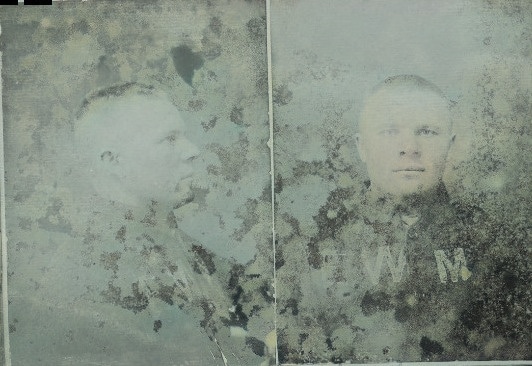
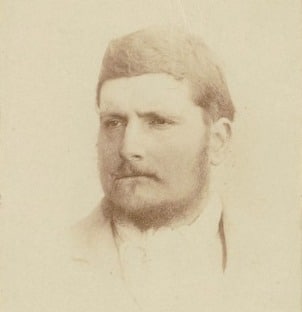
August Tisler worked for market gardener Edward Sangal, and became his employer’s wife’s lover long before Sangal’s body was pulled from the family well outside Melbourne, his throat cut. Tisler’s written confession described how the wife lifted a blind to show him a lit window, the signal that it was safe to come in and kill her husband, and how she then calmly staged the death as a suicide, leaving his slippers by the well so police would believe he had drowned himself.
At trial, Tisler repeated that confession almost word for word, while Selina Sangal denied any part in the plan, insisting she had been paralysed with fear as she heard her husband call her name during the struggle. A jury convicted them both and sentenced them to death, but Selina’s execution was deferred because she was close to giving birth. Tisler alone was hanged at Melbourne Gaol on this day in 1902, the drop breaking his neck instantly.
He showed remorse for the killing itself, telling the sheriff on the scaffold, “Whatever I have done in this world I am prepared to suffer for now.”
August Tisler: Public Record Office Victoria (PROV), Central Register for Male Prisoners, 29937–30336 (1902–1903), VPRS 515/P0000.
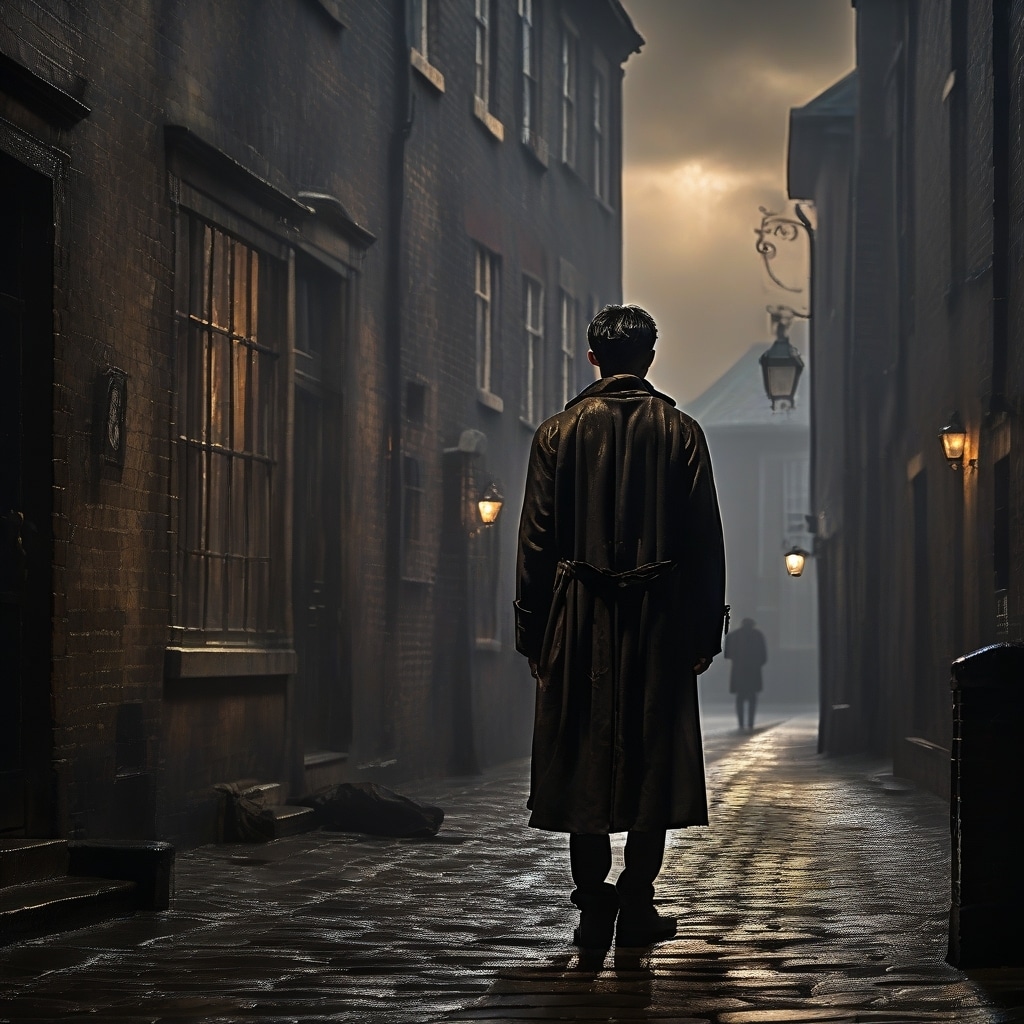
Richard Whittingham is barely past boyhood when he abandons his apprenticeship and steps into London’s criminal underworld. As Lives of the Most Remarkable Criminals recounts, his downfall begins not with malice but with weakness: an easy temper exploited by the wrong company and the relentless demands of women who trade affection for coin.
His story is the kind of true crime narrative that reveals how quickly a young life can unravel in Georgian London. Whittingham is not born a villain; he is made one, piece by piece, by appetite and circumstance, until the streets themselves become his trade.
The world he enters is one of coordinated violence and fragile loyalty, where the very companions who share the spoils are also the ones most likely to turn. Lives of the Most Remarkable Criminals lays bare every detail of this descent in its own unflinching prose; listen now and hear it told aloud.
Click the RSS feed link below to subscribe and get new episodes the moment they drop.
Subscribe via RSS
Dark Lexicon: Old words. Dark meaning.
The past speaks its own dialect; here is what to listen for in this episode.
Footpad: today the word means nothing to most people, but in the eighteenth century it was instantly understood and deeply feared. A footpad was a robber who worked on foot, as opposed to the more glamorous highwayman on horseback. There was nothing romantic about a footpad; they were street-level predators who relied on speed, surprise and numbers.
Hot-presser: this was a tradesman who used heated plates to press and finish cloth, giving fabric a smooth and lustrous surface. It was a respectable trade, the kind of steady apprenticeship that might have kept a young man out of trouble; Whittingham chose otherwise.
Cutting off women’s pockets: today a pocket is sewn into a garment, but in the early eighteenth century women wore separate pouches tied around the waist beneath their skirts. Thieves would literally slice the strings and snatch the pocket away. This is also the origin of the term ‘pickpocket,’ though the method here was closer to outright robbery.
Impeached: we think of impeachment now as a political process, a formal accusation against a president or officeholder. In this era it meant something rawer and more personal: one criminal informing on another to save his own skin. To be impeached by a companion was to be betrayed from within.
Passenger: in modern usage a passenger is someone riding in a vehicle, but in early eighteenth-century English it simply meant a person passing by on foot. The victims of Whittingham’s gang were ordinary pedestrians walking London’s broad streets.
Condemned hold: this was the section of Newgate Prison where those sentenced to death were confined in their final days. It sat deep in the building, dark and airless, and the condemned could hear other prisoners beneath them through cracks in the floor; a last cruelty layered on top of all the others.
Dissolution: today the word carries a formal, almost bureaucratic tone; the dissolution of a company or a parliament. In this context it means death itself: the dissolving of body from soul. It was the polite, prayerful way of naming the thing that waited at Tyburn.
About This Series
Lives of the Most Remarkable Criminals is one of the earliest works of true crime writing in the English language, nearly 300 years old, covering murderers, thieves, highwaymen, forgers, coiners and worse.
The book is entirely in the public domain and every word of it can be read today for free. But if you would rather listen, this podcast does exactly that: one criminal at a time, every week, read aloud.
True crime was not invented by podcasts or streaming services. Eighteenth century readers were just as fascinated by outlaws and killers as we are today. They just consumed their dark stories by candlelight.
The voice you hear is David Dark: crime researcher, theatre script writer, producer of live immersive experiences, and audiobook narrator and voice artist. This podcast uses an AI voice model trained on David’s own voice, built using the maximum available training data to faithfully represent how he actually sounds. To hear David’s real voice in human generated form, visit him on Audible, Online Stage, Voices of Today, Spoken Realms, and Internet Archive.
William Miller, a labourer at Hawkesbury near Sydney, attacked Bridget Horan (also recorded as Kean) with a hoe on the afternoon of 18 September 1805. Minutes later he ran to a neighbour and blurted out the truth: “Yes: I have killed Biddy, and am going to deliver myself up.” He then led the chief constable straight to her body himself, the hoe still lying beside it.
At his trial before the Court of Criminal Jurisdiction in Sydney, Miller pleaded not guilty to acting with malice, insisting the killing had come from unbridled momentary rage rather than intent. The court was unconvinced. He was convicted and hanged on 30 September 1805, his body afterwards handed over for dissection.
Witnesses said Miller never wavered from his confession, going to the gallows with what observers called sincere repentance, seemingly resigned that only his own death could answer for hers.
Moments after the bolt was drawn at the Campbell Street Gaol in Hobart, the chaplain stepped forward and read aloud a letter the dead man had written the day before in the condemned cell. It was addressed “To all men at Port Arthur”, and Martin Lydon had begged that it be made public.
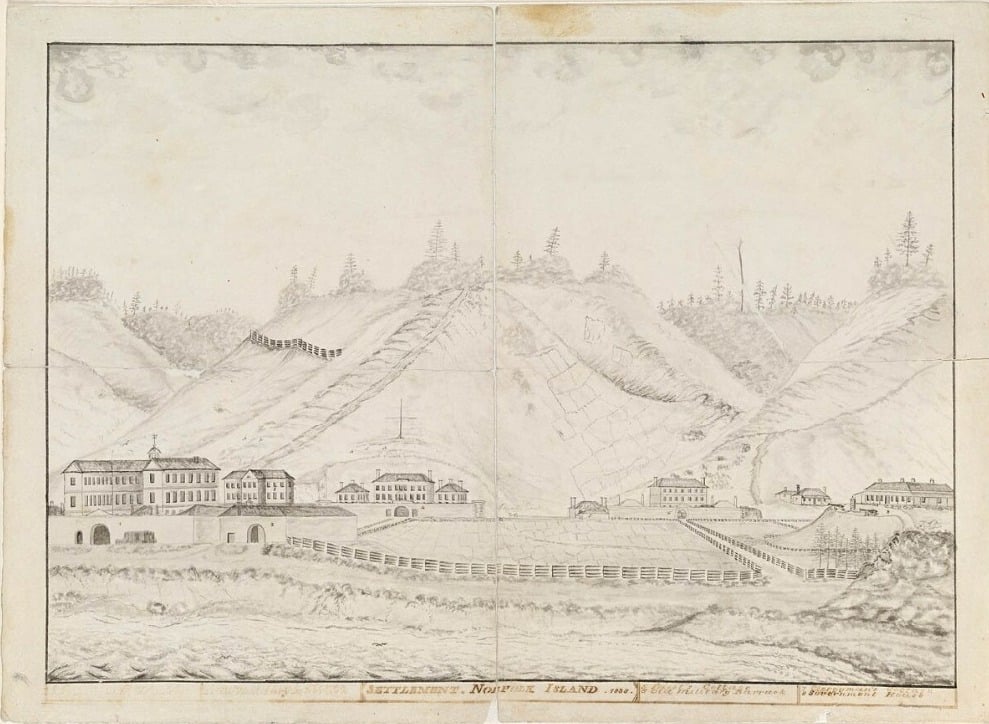
It was the story of a ruined life in a few lines. Disobedient at ten, a soldier at 16, Lydon struck an officer of his company in a moment of anger and was flogged: “this ruined me”. He came to hate the army and took to drink, and further violence saw him transported. “The vileness of Norfolk Island turned me into an animal,” he wrote. Only three weeks earlier, in H division, he had boasted that he did not care about being hanged. Now he called that his “wicked flashiness”: “Every man about to die must fear the judgment of God.”
Lydon had been capitally convicted in the Supreme Court of a felonious assault at Port Cygnet, south of Hobart, committed while drunk, a crime that then carried the death penalty. Lydon disputed part of the evidence given at his trial, but he did not dispute the sentence: what he had done in his drunkenness, he wrote, deserved death. “May the drunkenness that brought on me this misery be a warning to all of you.”
Norfolk Island settlement, 1838. Ink and wash drawing, artist unknown. State Library of New South Wales, SV8/Norf I/5.